02 January 2016

1815: The Battle of New Orleans

Fold3 has this for 8 January:
On the morning of 8 January 1815, British forces attacked American positions outside of New Orleans, Louisiana, resulting in a bloody defeat for the British in the last major battle of the War of 1812.
In the days leading up to 8 January, the British, under Edward Pakenham, and the Americans, under Andrew Jackson, had clashed in a series of smaller conflicts, as the British landed in the area to capture New Orleans and continue their campaign to gain a toehold on the Gulf.
 
In late December, Jackson (painting, above) had his main force dig in south of New Orleans at Chalmette Plantation, building defensive breastworks along a canal that stretched from the Mississippi River to the cypress swamp not far to the east. He also had a smaller force of men man a line across the Mississippi on the west bank.
The British plan was to use their greater number of men to launch an attack on both sides of the river simultaneously, with the British forces on the more heavily-defended east bank aiming to hit both the right and left flanks of the American line.
Things didn’t go as planned for the British, however. The smaller group of British troops who were to attack the west bank were delayed and, over on the east bank, the ladders and fascines needed to scale the American defenses failed to arrive when needed. In addition, the bulk of the British forces were commanded to attack the Americans’ left flank on the east bank, because it was believed to be weaker but, in reality, it was actually more heavily defended.
Intense fire and a stalwart defense from the Americans on the east bank, combined with the British problems, resulted in mass casualties for the British who, in most cases, failed to even reach the American line on that side of the river. The British commanding general, Edward Pakenham, was killed during the battle, and other high-ranking field officers as well as a significant number of the officer corps were also wounded or killed, leaving the British troops on the field essentially leaderless. When the commander of the British reserves found himself unexpectedly in charge of the British attack, seeing his fleeing soldiers and the carnage on the battlefield, he decided to have the troops withdraw.
Over on the west bank, despite the delayed start, the British were successful in routing the Americans and capturing some of their guns. However, their victory came too late to reverse the disaster on the east bank.
Rico says we got lucky...

Places Rico has lived

General Hospital, Trenton, New Jersey (no photo available)

14D South Chestnut, Bordentown, New Jersey (no photo available)

34 South Lane, Levittown, Pennsylvania

25 Merry Road, Newark, Delaware

1002 Dixon Drive, Newark, Delaware

995 Matadero, Palo Alto, California (now replaced by a much larger house)

995 Matadero, Palo Alto, California (new)

4292 Wilkie Way, Palo Alto, California (no photo available)

South Whitclem, Palo Alto, California (no photo available)

Barron Avenue, Palo Alto, California (no photo available)

Wharf, Nantucket, Massachusetts  (no photo available)

113 Main Street, Nantucket, Massachusetts

Donner Hall, Carnegie-Mellon University, Pittsburgh, Pennsylvania


543 South Graham, Pittsburgh, Pennsylvania

6530 Mañana Place, La Jolla, California

Middlefield Road, Palo Alto, California (no photo available)

San Antonio Road, Los Altos, California (no photo available)

St. Augustine, Florida; rented a condo at the golf course (no photo available)

Jefferson Hospital, 132 South 10th, Philadelphia, Pennsylvania

Bryn Mawr Rehab, 414 Paoli Pike, Malvern, Pennsylvania


514 East Lancaster, Wynnewood, Pennsylvania

The case for an entirely new calendar


The BBC has an article by Renuka Rayasam about changing the calendar:
If Richard Henry had his way, we wouldn’t be celebrating the New Year quite yet. The Johns Hopkins University physics and astronomy professor, along with his colleague Steve Hanke, an economics professor, have come up with a calendar they believe would simplify scheduling and accountancy once and for all.
More than four centuries ago, Pope Gregory XIII designed the calendar we use today as a fix to the Julian calendar, which had miscalculated the number of days it takes for the Earth to revolve around the sun. He wanted to keep Easter in the Spring, but also created a calendar riddled with idiosyncracies.
In the Hanke-Henry Permanent Calendar, every date would fall on the same day of the week every year. The pair want their calendar adopted worldwide by 1 January 2017, the next time that New Year’s Day falls on a Sunday. Their goal is to do away with scheduling problems and financial reporting errors that result from using a calendar system, where quarters and months are different lengths and dates jump to a different day every year.
In their proposed calendar, two thirty-day months are followed by one thirty-one-day month with an extra week called Xtr added on every five or six years to account for seasonal drift.
The pair say their calendar improves upon previous efforts because it preserves the twelve month, seven-day week idea, while eliminating what they call “calendar confusion.” Because the days don’t jump around from year to year in their version, scheduling for things like holidays, sporting events, and university start dates would only need to be planned once and then never changed. Christmas, for example, would always be on a Sunday.
Calculations would also be easier, they claim. Bond, mortgage, and other interest rate calculations are often based on a thirty-day month, which Hanke said leads to tricky sums and errors with months that have 28 or 31 days. “Our calendar solves that problem” because it would do away with the need for day count conventions all together, Hanke said.
In addition, because each quarter in the Hanke-Henry calendar is 91 days, corporate quarter calculations would become easier. As an example they point to Apple’s 2012 fourth quarter earnings, which fell short of Wall Street expectations, sinking the company’s share price. It turns out that analysts failed to account for the extra week that Apple had added to the fourth quarter in 2011 to account for leap days.
Henry first got the idea to revise the calendar when he started teaching an astronomy class to students at Johns Hopkins in Baltimore, Maryland. Even though the content of his class never changed, he had to update the syllabus, lecture, and exam schedule every year.
“The only reason that is necessary is because the world adopted the Gregorian calendar,” said Henry. “As a professional astronomer, I knew there had to be a better way.”
The snag for solar calendar planners is that it takes 365.2422 days for the Earth to orbit the Sun, complicating any sort of neat division of days and months. For most of history, religious concerns rather than business interests have shaped calendar planning.
Many countries today such as Bulgaria, China, Iran, and Israel use other calendars in parallel to the Gregorian calendar to mark holidays and religious observances.
This centuries-old calendar makes modern day scheduling and accounting a nightmare, but reformers have had little luck in convincing the world to move away from it.
In the early twentieth century “economic interests behind calendar reform came together,” said Vanessa Ogle, assistant professor of history at the University of Pennsylvania and author of The Global Transformation of Time. The rise of complex multinational firms, globalization, and cost accounting gave momentum to the movement to replace the Gregorian calendar with a more business-friendly version.
 Chambers of Commerce in the United States and Europe wanted to find a way to simplify revenue and cost comparisons difficult with the Gregorian calendar because months contain an uneven number of days. Many Western governments, just starting to measure economic activity more precisely, were also behind the idea of calendar reform, she said.
The United Nations even took up the cause in the 1950s, pushing for the adoption of a calendar with a fixed number of days in the quarter, but couldn’t get the US government on board.
The challenge became a personal passion for Eastman Kodak Company founder George Eastman. Within the Kodak offices, he implemented a thirteen-month calendar called the International Fixed Calendar (photo), designed by railway bookkeeper Moses Cotsworth. Every month had 28 days, with an extra month called Sol in the summer and a leap day added at the end of December.
Eastman believed that the calendar “kept things running efficiently and maintained good records,” said Kathy Connor, a curator for the George Eastman Museum. “Eastman spent a lot of money publishing and printing these calendars, because he wanted to convince other businesses to use it internationally.” He even addressed the League of Nations on the importance of calendar reform.
Robert Shanebrook remembers storerooms at the company’s offices piled high with calendars that came in different sizes. Every conference room in the building had a poster sized calendar of the current and following years hanging on the walls, and every employee had smaller calendars on their desks.
“I carried one in my wallet for years and I bet ninety percent of the men who worked there did too,” said Shanebrook, who held numerous jobs throughout his years with the company.
As Kodak started dealing more with outside vendors and bringing in external executives, it finally ditched the Fixed Calendar in 1989. Ogle says that other calendar-reform efforts largely died out over objections from religious groups worried that Sabbath wouldn’t be celebrated on the proper holy day, plus “some people associated the thirteen-month calendar with bad luck and fortune,” Ogle said.
Henry says that the biggest barrier to adopting the calendar has been psychological. For example, because birthdays would always be on the same day each year, he gets a lot of resistance to people whose birthdays would always be on a weekday. “The real objection is that people say ‘my birthday would always be on a Wednesday,’” he said.
Another barrier is the cost and coordination associated with switching calendars globally. With today’s networked global economy, every country around the world would have to agree on the new calendar to coordinate business meetings and airplane schedules among a host of other events. “It would be a lot of work for one year,” said Henry, as the world would need to reprint and adjust to new calendars and software makers would need to rewrite lines of code. “The one-time cost would be significant, but amortized over the next million years it would be zero.”
Still there is precedent for the shift. Ogle points out that the world didn't agree on common, uniform timezones until the middle of the twentieth century.
Whether the Hanke-Henry Permanent Calendar will get adopted globally by 2017 is still a good question. The pair say they get weekly emails from people who see their calendar as logical, but say they are having trouble getting it on the agenda of decision makers.
“We’re optimistic with social media,” said Hanke, who hopes that a grassroots effort could give the calendar momentum. Time will tell.
Rico says it's got his vote, but it won't happen in his lifetime...

Rules for rape


The Clarion Project has an article about yet more barbarity from the Islamic State:
Islamic State theologians have issued detailed rulings, on who can rape sex slaves and when, in a detailed fatwa. The fatwa was seized by the American military as part of a trove of documents captured earlier this year in a raid that killed Islamic State financial officer Abu Sayyaf in May of 2015. Reuters has been running exposes on some of the documents seized in the raid, including this fatwa:
Fatwa No. 64, dated 29 January 2015, issued by the Islamic State's Committee of Research and Fatwas is structured as warnings to “some of the brothers” who “have committed violations in the matter of the treatment of the female slaves” which ISIS feels “are not permitted by Shari'a law.”
To avoid future misunderstandings the fatwa department codifies the rules of sexual slavery thus:
A slave owner can not rape his female-slave if she is pregnant or menstruating.
He may not rape both a mother and daughter if he owns both women.
He may not rape two sisters if he owns both; he must choose only one. If he sells one however, the other becomes permitted.
A son may not rape the slave of his father, nor the father the slave of his son. Neither may a husband rape his wife’s slave. Selling or giving away the girl changes this.
A slave owner is not allowed to abort a fetus of his slave impregnated by  him. 
There are also injunctions to treat slaves well:
The owner of a female captive should show compassion towards her, be kind to her, not humiliate her, and not assign her work she is unable to perform.  
For an organization infamous for its draconian approach to crime and punishment, specific penalties for breaches of these rules are conspicuous by their absence.
Another pamphlet, translated by scholar and Islamic State expert Aymenn Jawad al-Tamimi, lays out the Shari'a basis for taking captives in war, including sex-slaves, providing instruction on who fighters are allowed to capture and enslave:
“For the disbelievers who have no pact of the dhimmi, ceasefire, or security between them and the Muslims, the principle regarding them is that their blood and property are free for pillage if they do not convert to Islam or pay the jizya and enter under the rule of Shari'a” the pamphlet reads. “In this regard their women and offspring may be taken captive.”
The pamphlet stipulates that it is not permissible to rape female captives until they are confirmed as slaves, since the imam may decide to either release or ransom them. Only non-Muslims may be taken as captives, and of those, not Jews and Christians who have agreed to submit to the caliphate under a pact of dhimma.
Rico says but it's the religion of peace and love, right?

The end of Hitler's hloodline?


War History Online has an article about Hitler's descendants:
The five descendants of the Nazi leader are the two sons of Hitler’s half-sister, Angela Hitler, Peter Raubal and Heiner Hochegger; as well as the three other sons of Alois Hitler, Jr., the dictator’s half-brother: Alexander, Louis, and Brian Stuart-Houston.
Hitler (photo) may have devoted his whole life trying to perfect the human race through the elimination of the weak and the disabled and ethnic groups he deemed inferior (like the Jews). He saw the Aryans as the components of the Master Race and had ordered, in his years of rule, the death of countless millions of innocents to move humanity to that impeccable line he was seeking.
But because of this obsession, the hideous events and mass killings, Hitler’s descendants decided that their bloodline, that of the man who saw himself as the zenith of the Master Race, is very undesirable, resulting to a silent agreement to intentionally kill it.
“They didn’t sign a pact, but what they did is, they talked amongst themselves, talked about the burden they’ve had in the background of their lives, and decided that none of them would marry, none of them would have children. And that’s a pact they’ve kept to this day,” according to David Gardner, writer of the Last Days of Hitler. He had tracked down the last surviving members of Hitler’s family in the 1990s and discovered their pact.
Peter Raubal, who was born in 1931, is currently 82 years old. A retired engineer, it looks like he has no plans to keep the Hitler bloodline alive. His younger cousin, Heiner Hochegger, was born in 1945, making him 68 years old today. However, like Raubal, he doesn’t have any children, and will most likely remain that way until his death.
The Stuart-Houston brothers, sons of Hitler’s half-brother, are aged from 48 to 64 today. They may still be capable of fathering children, but the brothers show no desire in procreation. As children, they made an agreement to avoid having kids of their own to deliberately wipe out their infamous lineage.
When it comes to Adolf Hitler’s parentage, especially in his father’s side, there are still many things to tackle. For one, many historians accept Johann Georg Heidler was the dictator’s grandfather. Nevertheless, Johann’s younger brother, Johann Nepomunk Heidler, is also a contender to that position. The older Johann married Maria Ann Schickelgruber, becoming the legal stepfather of her then five-year-old son, Alois, Adolf Hitler’s father.
There was no father’s name written in Alois’ birth certificate. Many speculations have surrounded that missing piece; some believed Johann Nepomunk was Alois' real father, but was ashamed to admit it because he was married to another woman or that, perhaps, Johann Georg was really his father and that he fathered him before he and Maria got legally married.
On the other hand, Hitler’s maternal lineage started with Johanna Heidler, the daughter of Johann Nepomunk and his wife, Eva. Johanna married Johann Baptist Pölzl, and the couple had five sons and six daughters. Klara Pölzl, one of the pair’s daughters, became the third wife of Alois and gave birth to Adolf Hitler.
Given the circumstances that Johann Georg Heidler was the biological father of Alois, Klara and he would have been first cousins once removed. If Johann Nepomunk were Alois’ real father, then, Alois would have been Klara’s uncle. One way or the other, the two had such very close relations that an appeal letter had to be written to the church as a humanitarian waiver, asking for marriage permission for the two.
This was granted. Alois and Klara became husband and wife on 7 January 1885. Four years later, on 20 April 1889, Adolf Hitler was born. The two had other children, but only he and a sister named Paula survived to adulthood. However, the two did not have families of their own. Hitler committed suicide in 1945, and Paula passed away in 1960 without any family.
However, from his former wife, Alois had other children. One daughter was Angela Hitler, who was from his second marriage. Angela had three children, Leo Raubal, Jr., Angela “Geli” Raubal, and Elfriede Raubal. The only girl among her brood, Geli, committed suicide in 1931. She purportedly had a sexual relationship with her dictator uncle, and was believed to be murdered, though police had ruled it was suicide. She had no children.
Meanwhile, Leo and Elfriede both had sons: Peter and Heiner. Both these men are part of the five men who are seen as the hope of keeping Hitler’s lineage alive, but they have no intention of doing so as both, until now, do not have families and children of their own.
Another child of Alois and the half-brother of Adolf Hitler, Alois, Jr., had two sons from two various women. His first wife, who was English, bore him a son, William Patrick. But he left his first family in England behind, went back to Germany and married again. He and his second wife had a son, Heinrich, who died at the tender age of 21 as a Nazi soldier. He had no children of his own when he died.
William, on the other hand, had hoped he could gain financially when his uncle rose to power. So, he sailed from England with high hopes that his uncle would give him a profitable job. However, through all the jobs the dictator gave him, first in a car dealership, then in a bank and, finally, in an automobile factory, he had no satisfaction. So he started blackmailing his uncle into giving him a better job, or he would let out the family’s skeletons in the closet to the newspapers. In 1938, Hitler asked William to denounce his British citizenship so he could be given a high-ranking post. But the latter, suspecting it was a trap, fled Germany. He then tried to blackmail his uncle again, threatening him that he would expose to the public his paternal grandfather was a Jew (though this allegation had been cleared by the historians as untrue). When he arrived in London, William proceeded to write an article for Look that had the title Why I Hate My Uncle, and made a living touring and speaking about Adolf Hitler.
When World War Two broke out, he and his mother had been on tour in the US. They were stranded in the country, but William made a special request to then-President Franklin D. Roosevelt, which allowed him to join the Navy in 1944. He moved to New York City and worked as a Pharmacist’s Second Mate, until he was discharged in 1947 after being wounded.
After he left the Navy, William changed his surname to Stuart-Houston and moved to Long Island. He eventually got married and had four sons. His third son, Howard Ronald, was connected to the Criminal Investigation Division of the Internal Revenue Service as a special agent. However, he died, childless, in a car accident in 1989.
William’s three other sons complete the ‘five hopes’ for the survival of Hitler’s bloodline. Alexander, Louis, and Brian are the youngest of this brood but, as of this time, they have remained childless and if their silent pact is taken into account, should remain that way until their deaths.
Rico says it's taken a long time to kill the sumbitch off...

History for the day


At 2100 on 2 January 1905, General Nogi of Japan (photo, right) received from General Stoessel of Russia (photo, left) a letter formally offering to surrender, ending the Russo-Japanese War.

Quote for the day

"My family has begged for food since the Ming dynasty. I'm the nineteenth generation."

Ding Xinfeng, a homeless man in Beijing, China who, like many others across East Asia,
finds refuge overnight in a 24-hour McDonald's restaurant.

Rico says that McDonald's probably wishes they wouldn't...

Civil War for the day


On 22 December 1864, Union General William T. Sherman sent a message to President Abraham Lincoln from Georgia, saying: "I beg to present you, as a Christmas gift, the city of Savannah."
Atlanta is ours, and fairly won,” declared Sherman when he captured Atlanta. Sherman had taken the South’s major manufacturing center and railroad hub, a huge loss for the Confederacy.

Cartoon for the day

Rico's friend Kelley forwards this Ballard Street:

Star Wars for the day

Nick Steinberg has a Goliath article about bad Star Wars decisions:
Star Wars isn’t exactly known for its stellar display of acting prowess. Sure, many of those involved (especially in the first trilogy) give completely convincing, well-regarded performances that reflect the franchise’s melodramatic space opera aesthetic perfectly. That being said, not everyone can be in the same league as a Harrison Ford or Ewan McGregor. Miscasting happens all the time in movies, and Star Wars is no exception.
While there are not many examples of obvious miscasts in the Star Wars franchise, the ones that do exist stick out like a sore thumb. Admittedly, the blame can’t be solely placed on the actors, as they were often given material of suspect quality to work with in the first place, and it isn’t exactly easy to turn garbage into gold. None of the following actors are necessarily “bad” at acting (in fact, half of them are extremely well-regarded in their field), but for whatever reason, they just weren’t right for Star Wars and, arguably, should have been replaced long before the final cuts were sent to theaters.
You’ll notice that this list does not include any actors from the original trilogy. We didn’t intend to only single out the prequels, but there aren’t really any casting choices we would want to change in the early Star Wars films. Maybe David Prowse (have you heard how awful his Darth Vader voice is?) but James Earl Jones’ iconic voiceover improvements make make even that a moot point. 
7. Liam Neeson
You’re probably surprised to see Neeson here, considering his presence is one of The Phantom Menace‘s few saving graces. If you think about it though, what distiguishing characteristic does Qui-Gon Jinn have other, than the fact that Liam Neeson played him? Qui-Gon is completely devoid of charisma or even a clearly-defined belief system, recklessly undermining those around him at every turn. The simple truth of the matter is that Qui-Gon was a poorly-written character and Neeson was much too overqualified to play him. While it’s still neat to think that Liam Neeson actually appeared in Star Wars, his character was so poorly-realized that any middle-aged bloke could have played him. At least Neeson only had to suffer for one film.
6. Natalie Portman 
Natalie Portman is a talented actor who has turned in mesmerizing performances in films such as Black Swan and V For Vendetta, but even she admits that appearing as Padmé Amidala in the Star Wars prequels was almost an act of career suicide. “Star Wars had come out around the time of Seagull, and everyone thought I was a horrible actress,” said Portman in an interview with New York Magazine last year. “I was in the biggest-grossing movie of the decade, and no director wanted to work with me.” Of course, Portman is a well-regarded actor today but, if you look at her performance in Star Wars, there’s little resemblance to the woman who would go on to win the Academy Award for Best Actress. While it’s unreasonable to lay the blame squarely at Portman’s feet (the material she had to work with was largely atrocious), she did no favors for herself by giving a wooden, disinterested performance in three separate Star Wars films.
5. Samuel L. Jackson
Samuel L. Jackson generally improves any movie he’s in, which is why it’s still so surprising just how much of a dud his character was in Star Wars. Jackson played Mace Windu, the Jedi Master with the distinctive purple lightsaber and pretty much no other distinguishing features. George Lucas and Company seemed to forget that, if you’re going to cast Samuel L. Jackson in your movie, you let him be Samuel L. Jackson. Instead, the usually cool and charismatic actor was largely wasted on a character who really didn’t contribute much to the prequel trilogy besides taking out Jango Fett and nearly taking out Emperor Palpatine (with a poorly executed plan of attack to boot). Mace Windu had all the right ingredients for an interesting character but, unfortunately, not even Samuel L. Jackson could make it a reality.

4. Daniel Logan
It’s a bit unfair to pick on child actors for being miscast in a role, but when they’re as annoying and obtrusive as Daniel Logan’s turn as a young Boba Fett, a little criticism is warranted. To be fair to Logan, inserting a young Boba Fett into Attack of the Clones was a terrible decision to begin with. Fett’s popularity largely stemmed from him being such an enigmatic badass; showing him as a pouty, obstinate child almost tarnished that perception entirely. If Lucas was insistent that a young Fett needed to turn up, he probably should have aged the character a bit to, at least, give the impression that he one day grows up to become the galaxy’s most notorious bounty hunter. Instead, they chose Daniel Logan, who unfortunately just came across as really annoying. He could have been cut from the movie and it wouldn’t have made a difference (unless you count witnessing his dad get his head chopped off by Mace Windu as important, but the film never did anything with that traumatic moment anyway to warrant its inclusion).

3. Jake Lloyd
The Phantom Menace had a great opportunity to introduce a young Anakin Skywalker to the audience who they could identify with in a similar way to his son Luke in Star Wars. Instead, we got a little annoying kid played by Jake Lloyd. Lloyd is perhaps the most unfortunate victim of the prequels, as the pressure of being the central character in a new Star Wars film at the age of eight turned the actor’s life into a “living hell” and made him quit acting altogether. Lloyd’s performance isn’t even that bad considering how young he was; it’s just hard to take an eight-year-old boy seriously as the central protagonist of any film, let alone Star Wars. Anakin should have been aged up in The Phantom Menace with a different actor in place of Lloyd; at the very least it would have made his scenes with Natalie Portman’s character (aka his future wife) a lot less awkward.

2. Ahmed Best
While it’s hard to fault Ahmed Best for being the unfortunate soul who had to voice Jar Jar Binks, his performance was so universally despised (except by the very young and ignorant) that he is probably just as eager as anyone to forget he ever had anything to do with it. We’re not making the argument that another actor could have done a better job with Jar-Jar because, let’s be honest, nobody could. Still, casting Best was a poor decision because his line delivery still haunts our dreams and even worse, it tainted his acting career, as Jar Jar remains his biggest role to date. And people say that Jar Jar isn’t evil…

1. Hayden Christensen
It feels wrong to continually heap criticism on Hayden Christensen for his turn as Anakin Skywalker in Attack of the Clones and Revenge of the Sith (he’s received enough of it already), but it’s hard to deny that he was the biggest miscasting in Star Wars history. A fair portion of the blame can be attributed to the poor scripts the actor had to deal with, but, considering co-stars such as Ewan McGregor and Ian McDiarmid had little trouble in rising above the script problems and turning in memorable performances for their respective roles, it’s hard not to think that there was room for considerable improvement had Christensen only been able to rise to the occasion. It’s a shame that his performance was so reviled, because it arguably tarnished his reputation considerably; it would have been nice to see the actor get more opportunities to prove he’s a more capable talent than this compilation would suggest:

Rico says any actor would kill to have any part in a Star Wars movie...

Hitler vs Donald Duck

Disney, in a moment of patriotic fervor, created Der Führer’s Face:


Der Führer’s Face (originally titled Donald Duck in Nutzi Land) is a 1943 American animated propaganda short film produced by Walt Disney Productions and released in 1943 by RKO Radio Pictures. The cartoon, which features Donald Duck in a nightmare setting working at a factory in Nazi Germany, was made in an effort to sell war bonds, and is an example of American propaganda during World War Two.
The film was directed by Jack Kinney and written by Joe Grant and Dick Huemer from the original music by Oliver Wallace.The film is well known for Wallace’s original song Der Führer’s Face, which was actually released earlier by Spike Jones.
Der Führer’s Face won the Academy Award for Best Animated Short Film at the fifteenth Academy Awards, the only Donald Duck film to receive the honor. In 1994, it was voted number 22 of the 50 Greatest Cartoons of all time by members of the animation field.
However, because of the propagandistic nature of the short, and the depiction of Donald Duck as a Nazi (albeit a reluctant one), Disney kept the film out of general circulation after its original release.
Its first home video release came in 2004, with the release of the third wave of the Walt Disney Treasures DVD sets.

01 January 2016

Movie for the day

Rico says he and the fiancee watched the end of Close Encounters of the Third Kind, instantly recognizable, even from the other room, by the five-tone litany:

Gubs for the day

The New York Times has an editorial about gubs and Texas:

This is a big day for Texans yearning to flaunt their handguns in belt and shoulder holsters. A new “open carry” law enacted by the Republican legislature goes into effect on Friday, posing a challenge for law enforcement, businesses, and other institutions that are understandably wary of how social interchange will be affected.
It’s also a big day in Seattle, Washington, where the City Council’s new “gun violence tax” takes effect, levying a $25 charge on each gun sold and an ammunition tax of two to five cents per round. The law was upheld in December of 2015 by a county judge, who found it did not interfere with the right to bear arms and was a legitimate tax to finance gun violence research and help pay for its costly effects. If it survives appeal by the gun lobby, the taxation route deserves to be widely used as a tactic in battling the gun menace.
The contrasting developments in Austin, Texas and Seattle, Washington demonstrate politicians’ tug of war over gun rights and civilian safety, which the gun lobby has been manipulating by pushing through state laws that block local governments from enacting needed ordinances. The resulting crazy quilt of clashing interests demonstrates the need for federal laws, which, of course, have been rejected by a Congress captive to the gun industry’s agenda.
The effect of the industry’s power on local streets has the Houston, Texas police chief, Charles McClelland, worrying about how his officers will deal with openly armed citizens amid rising fears over mass shootings and terrorism. “How are they supposed to know who the good guy or the bad guy is with the gun?” he asks.
That’s a reasonable question, lost in the cheers from many of Texas’ million handgun owners with concealed-carry permits. For gun-rights advocates, the new law solves such problems as how to tote bulkier (and deadlier) large-caliber handguns that proved clumsy under the earlier concealed-carry rules. “We shouldn’t have to dress around our ability to carry,” C.J. Grisham, president of Open Carry Texas, said in something of a fashion statement to The Wall Street Journal.
The Texas law still bans handguns in courthouses, schools, sports arenas, and businesses that get more than half their profits from on-site alcohol consumption. But a whole new world of possibilities has been opened, prompting major grocery and restaurant chains and the Roman Catholic Diocese of Dallas to exercise the law’s provision to opt out, which requires a prominent sign prohibiting open carry on their premises. The First Baptist Church of Arlington, on the other hand, decided it was safe to allow its two thousand-plus worshipers to show up armed.
Texas had banned public packing of handguns after the Civil War. That was before the modern gun lobby worked to reverse gun safety laws to the point where variations of open carry now exist in 45 states. More and more, the open-carry movement is being used to make confrontational and intimidating protest statements.
The confusion for the public can be considerable. A woman called 911 in Colorado Springs, Colorado in October of 2015 when she saw a man toting a weapon in the street. She was told the gunman had that right under the open-carry law. The man began a shooting spree outside her door and randomly murdered three innocent people.
Rico says this problem ain't going away, as the article by Manny Fernandez and David Montgomery article in The New York Times points out:
Texas is so gun-friendly that it is easier to get into the Capitol in Austin with a firearm than without one, as licensed, gun-carrying lawmakers and members of the public have their own no-wait security lane, while the unarmed masses have to stand in line and slog through the metal detectors.
But on Friday, gun rights throughout the state expanded still more, as a new law took effect that allows certain Texans to wear their handguns in holsters on their hips or in shoulder holsters, Dirty Harry-style, openly displaying the fact that they are armed as they work, shop, dine, and go about their day.
The so-called open-carry law has set off a long-simmering debate over the limits of the Texas gun culture, and has given gun rights advocates a hard-fought victory after they pushed for the expansion for years. Members of the pro-gun group Open Carry Texas were to gather at noon Friday on the south steps of the Capitol for a gun-on-their-hips celebration before walking down Congress Avenue. Other groups plan to display their weaponry at events in Houston, Dallas and other cities.
“I think most people can expect Friday to be just like Thursday,” said C. J. Grisham, 41, a retired Army sergeant who formed Open Carry Texas in 2013. He says he plans to carry two semiautomatic pistols at the Capitol rally, and gave his thirteen-year-old daughter a pink .22-caliber rifle for her twelfth birthday. “I think everybody is overreacting.”
More than forty states allow some form of open carry. But Texas will become the most populous open-carry state, and the public nature of the debate and vote has produced measures of elation, anxiety, and confusion over the new law. The mixed emotions have prompted law enforcement agencies to hold public meetings and release informational videos to help put some residents at ease, particularly in the wake of high-profile mass shootings.
Open-carry supporters say more public weapons will help deter would-be criminals. Opponents say that police officers will have a hard time separating the good guys from the bad, and that there is no evidence that open-carry states are safer.
The change directly affects only a small fraction of Texans, the nearly a million men and women with active state-issued licenses to carry a concealed firearm, close to four percent of the state’s residents. Only those with a concealed-handgun permit are allowed to open carry, and all of them must submit their fingerprints and pass a criminal background check.
Texans do not need a state license to buy a handgun but must meet the Federal qualifications. If Texas gun owners want to carry their handguns outside their home, they must apply for a license through the Texas Department of Public Safety, be at least 21 and complete training courses and a written examination.
State lawmakers and gun rights advocates have played down the effect of the new law, saying that they believe that the majority of those licensed to carry a firearm will choose to keep it concealed. Even the author of the law, State Representative Larry Phillips, a Republican from Sherman, said he did not plan on routinely wearing his handgun on his hip. “I don’t think you’re going to see a major change,” Phillips said. “Most people I talk to say they’re going to conceal carry.”
Tim Vasquez, the chief of police in the West Texas city of San Angelo and the president of the Texas Police Chiefs Association, said police officials were bracing for “a huge learning curve” as they begin enforcing the law.
“Most of us do support concealed, but we also understand that open carry creates a whole new set of problems,” Vasquez said. “If our officers see someone with an open carry, they do have the ability to stop and identify whether that person is permitted or not.”
Gun rights will advance again in August, when students and faculty members at Texas universities will be allowed to carry concealed handguns on campus, although openly carrying is prohibited.
The new open-carry law allows businesses to ban the visible wearing of handguns, by posting signs with specific required wording in English and Spanish. Merchants and restaurant owners have been busy in recent weeks deciding what to do, and gun rights advocates have vowed not to spend money anywhere that bans open carry.
One pro-gun website, Texas3006.com, has been keeping track of the businesses that have posted signs and created a Wall of Shame for those with the most entries (at the top of the list was the Sprouts grocery chain).
Opponents of open carry have publicized their own lists, including the national group Moms Demand Action for Gun Sense in America, which applauded H-E-B grocery stores, the Chuy’s Tex-Mex restaurant chain, and others for banning open carry.
“We feel customers and employees will feel safer when people are not openly walking around with guns,” said Anna Kehde, the Texas chapter leader of Moms Demand Action. “It’s hard to tell who is a responsible gun owner and who is someone I should seek cover from.”
Certain places are off-limits to concealed and unconcealed handguns under Texas law in most cases, including sporting events, amusement parks, bars, courts, government meetings, and places of worship.
The law has brought renewed attention to the state’s licensed gun carriers, and questions of who will and who will not open carry. John Wittman, a spokesman for Governor Greg Abbott, a longtime proponent of gun rights who signed the bill into law in June, declined to comment when asked whether the governor would openly carry. A spokesman for Lieutenant Governor Dan Patrick, who also has a concealed-carry license, said Patrick did not plan on openly carrying.
For many pro-gun Texans, the arrival of open carry is not enough. Many of them did not support the open-carry bill but instead called for legislation for what they called “constitutional carry”, allowing Texans to display and wear their handguns regardless of whether they were licensed to carry a concealed firearm because, they argued, the Second Amendment gives them the right to do so. They are urging the passage of a constitutional-carry bill in the next session of the Legislature.
The new law is anticlimactic for one other reason: Texas has no prohibition on the open carrying of rifles, shotguns, and other long guns, a right that gun owners have taken advantage of in recent years by showing up at open-carry rallies and other events with loaded AR-15s and other military-style rifles strapped across their backs.
Rico says that Texas ain't like other places...

An overview of the Crusades


Rico's friend Kelley, also a history fiend, forwards this from The Federalist, with the comment that "Muslims are always whining about the monstrous injustice that the Crusades inflicted upon them. This article puts it all neatly in perspective":
In light of President Obama’s recent remarks, comparing the brutality of the Islamic State to the Crusades, it might be time to take a fresh look at those events. Were they really the one-sided Dark Ages barbarism we have been taught? Were they an early manifestation of Western imperialism and global conquest?
In his landmark book, God’s Battalions, Baylor University social sciences professor Rodney Stark suggests otherwise. It is a well-researched chronicle, including seven hundred footnotes and a bibliography of about three hundred other works, yet reads like an adventure story full of military strategy and political intrigue.
He begins in the final years of Mohammed, and describes how a newly united Arab people swept through Zoroastrian Persia and the Orthodox Christian Byzantine-  controlled areas of Syria, Palestine, Egypt, and North Africa. (Byzantine refers to the Greek-speaking eastern remainder of the Roman Empire.) Eventually, the Arabs took over control of the Mediterranean islands, most of Spain, and the southern part of Italy, and even reached as far as a hundred or so miles outside of Paris, France before being turned back by the Franks.
The Muslims were brutal in their conquered territories. They gave pagans a choice of converting to Islam or being killed or enslaved. Jews and Christians (other People of the Book) were usually, but not always, treated somewhat better, and allowed to retain their beliefs, under conditions of Shari'a subjugation.
But the Muslim-held territories were not monolithic. Stark writes:
Perhaps the single most remarkable feature of the Islamic territories was the almost ceaseless internal conflict; the intricate plots, assassinations, and betrayals form a lethal soap opera. North Africa was frequently torn by rebellions and intra-Islamic wars and conquests. Spain was a patchwork of constantly feuding Muslim regimes that often allied themselves with Christians against one another.
Not surprisingly, there was intense Christian resistance and determination to take back lost territories. Especially effective were the Normans and the Franks in Spain and Italy.
Western scholars have often characterized this clash of cultures as an Islamic Golden Age versus a European Dark Age, but Stark demolishes this as a myth. He says the best of the Islamic culture was appropriated from the people Muslims conquered: Greeks, Jews, Persians, Hindus, and even from heretical Christian sects such as the Copts and Nestorians. He quotes E.D. Hunt as writing that “the earliest scientific book in the language of Islam was a treatise on medicine written by a Syrian Christian priest in Alexandria translated into Arabic by a Persian Jewish physician.” Stark writes that Muslim naval fleets were built by Egyptian shipwrights, manned by Christian crews, and often captained by Italians.  When Baghdad was built, the caliph “entrusted the design of the city to a Zoroastrian and a Jew.” Even the so-called Arabic numbering system was Hindu in origin.
And, while it is true that the Arabs embraced the writings of Plato and Aristotle, Stark comments:
Rather than treat these works as attempts by Greek scholars to answer various questions, Muslim intellectuals quickly read them in the same way they read the Qur’an, as settled truths to be understood without question or contradiction… Attitudes such as these prevented Islam from taking up where the Greeks had left off in their pursuit of knowledge.
Meanwhile, back in Europe, there was an explosion of technology that made ordinary people far richer than any had ever been before. It began with the development of collars and harnesses that allowed horses to pull plows and wagons rather than oxen, doubling the speed at which people could till their fields. Plows were improved, iron horseshoes invented, wagons given brakes and swivel axels, and larger draft horses were bred. All this, along with the new idea of crop rotation, led to a massive improvement in agricultural productivity that, in turn, led to a much healthier, larger, and stronger population.
War technology was also improving, with the invention of the crossbow and chain mail. Crossbows were far more accurate and deadly than conventional archery, and could be fired with very little training. Chain mail was almost impervious to the kind of arrows in use throughout the world. Mounted knights were fitted with high-back saddles and stirrups that enabled them to use more force in charging an opponent, and much larger horses were bred as chargers, giving the knights a height advantage over enemies. Better military tactics made European armies much more lethal. Stark writes:
It is axiomatic in military science that cavalry cannot succeed against well-armed and well-disciplined infantry formations unless they greatly outnumber them…. When determined infantry hold their ranks, standing shoulder to shoulder to present a wall of shields from which they project a thicket of long spears butted in the ground, cavalry charges are easily turned away; the horses often rear out of control and refuse to meet the spears.
In contrast, Muslim warriors were almost exclusively light cavalry, riding faster but lighter horses bareback with little armor, few shields, and using swords and axes. Their biggest advantage was their use of camels, which made them much more mobile than foot soldiers, and gave them the ability to swoop in and out of the desert areas to attack poorly defended cities.
These differences provided Crusader armies with huge advantages, but what would prompt hundreds of thousand Europeans to leave their homes and travel over two thousand miles to engage an enemy is a desert kingdom, especially after the Muslim conquest of Europe had been turned back?
There had been long-festering concern about the fate of Christian pilgrims to the Holy Land. After his conversion to Christianity in the early 300s, the Roman Emperor Constantine built the Church of the Holy Sepulchre on the site of what was believed to be Jesus’ tomb, and other churches in Bethlehem and on the Mount of Olives. These sites prompted a growing number of European pilgrims to visit the Holy Land, including Saint Jerome, who lived in Bethlehem for the last thirty years of his life as he translated the Bible from Greek and Hebrew into Latin. By the late fifth century, Stark reports, more than three hundred hostels and monasteries offered lodging to pilgrims in Jerusalem alone.
But, in 638, Jerusalem surrendered to Muslim invaders, and mass murders of Christian pilgrims and monks became commonplace. Stark includes a list of select atrocities in the eight and ninth centuries, but none worse than the some five thousand German Christians slaughtered by Bedouin robbers in the tenth century.
Throughout this period, control of Palestine was contested by several conflicting Muslim groups. Stark writes that “in 878 a new dynasty was established in Egypt, and seized control of the Holy Land from the caliph in Baghdad.” One hundred years later, Tariqu al-Hakim became the sixth caliph of Egypt and initiated an unprecedented reign of terror, not just against Christians, but against his own people as well. He burned or pillaged some thirty thousand churches, including the Church of the Holy Sepulchre and the tomb beneath it.
Soon enough, newly converted Turkish tribes came out of the north to seize Persia and Baghdad by 1045 and press on to Armenia, overrunning the city of Ardzen in 1048, where they murdered all the men, raped the women, and enslaved the children. Next they attacked the Egyptians, in part because the Turks were Orthodox Sunnis and the Egyptians were heretical Shi'ites. While the Turks did not succeed in overthrowing the Egyptians, they did conquer Palestine, entering Jerusalem in 1071. The Turks promised safety to the residents of Jerusalem if they surrendered the city, but broke this promise and slaughtered the population. They did the same in Ramla, Gaza, Tyre, and Jaffa.
Finally, they threatened Constantinople, the capital of the Byzantine Empire. Emperor Alexius Comnenus wrote to Pope Urban II in 1095, begging for help to turn back the Turks. This was remarkable, given the intense hostility between the Roman Catholic and Eastern Orthodox churches. Perhaps the Pope saw an opportunity to unite, or at least reduce, tensions between the two Christian churches, but he responded with a call to create an army that would go to the Middle East.
I am not going to regurgitate all the battles of the Crusades themselves. It is a fascinating history, well worth studying in part for its parallels and lessons for today. Let’s just say that the Crusaders were extremely effective militarily, often defeating far larger Muslim armies, despite having traveled nearly three thousand miles into an alien desert climate. Their biggest enemies were disease, starvation, and political betrayal. Plus, the Crusades were expensive and home countries grew weary of paying the taxes needed to support them. (Sound familiar?)
The Crusaders ended up establishing their own kingdoms in the Holy Land, which lasted for about two hundred years or, as Stark notes, almost as long as the United States has existed; but without ongoing support from Europe they could not survive constant attacks from the Muslims.
So, what to make of all this?
The current idea that Jews in Israel are usurping the rights of indigenous people is nonsense. This has always been a hotly contested area. In the Old Testament, the Jews wrested control from the Canaanites, then were overrun by the Assyrians, then the Babylonians, then the Persians, then the Greeks, then the Romans. The Romans of Jesus’ time were displaced by the Greek Byzantine Empire, then replaced by the Arabs, then the Egyptians, then the Turks, and finally by the British. For most of human history the wealth of a society was created by conquest and plunder. It is hardly unique to Christians, and certainly not to Jews.
Actually, the Crusaders were unique in that they did not seek to plunder or enslave. They didn’t even try to forcibly convert anyone to Christianity. Their sole interest was to protect the pilgrims and the Christian holy sites. They sometimes sacked cities that refused to provide food to a hungry army, but they didn’t take riches back to Europe. There were few riches to be found. Rather than exploiting indigenous resources to benefit Europe, Europe sent money and resources to the Middle East. Pilgrims were quite lucrative for host countries, just as tourism is today.
War was a nasty and brutal business at the time, and had been for all of recorded history. Cities fortified themselves as protection against invading armies. A siege of a city meant surrounding the area and cutting off supplies until the population surrendered, often by starving. In the Bible, II Kings 6:24-33 relates the story of the siege of Samaria, in which two starving women agree to kill and eat their sons.
The rule of war at the time was that, if a city surrendered, the population would be spared, but if it resisted and the invading army had to take it by force, all the inhabitants would be killed or enslaved. But Stark notes that Muslim armies often violated even this rule, promising sanctuary, then slaughtering the population that surrendered. (Before we get too smug and condescending about the savagery of these ancients, let’s not forget the rocket bombing of London, the firebombing of Dresden, and the atomic bombing of Hiroshima and Nagasaki a mere seventy years ago.)
One way in which Muslim fighters today have advanced over their forebears is that, during the Crusades, they did not adopt new tactics to counter the technological advantage of the Europeans. They never used crossbows or shielded infantry, even after several hundred years of fighting. Today, Muslim warriors quickly evolve to make the most of Western technology, although they still never seem to develop anything of their own.
One final thought on this. As Stark indicates, there is, in too many Muslim countries, a sense of obedience that precludes robust debate or new ideas, let alone technological innovation. In his classic book, The World is Flat, Thomas Friedman quotes Osama bin Laden as saying:
It is enough to know that the economy of all Arab countries is weaker than the economy of one country that had been part of our Islamic world when we used to truly adhere to Islam. That country is the lost Andalusia. Spain is an infidel country, but its economy is stronger that our economy because the ruler there is accountable. In our countries, there is no accountability or punishment, but there is only obedience to the rulers and prayers of long life for them.
Friedman confirms that this is based on a 2002 report, the first Arab Human Development Report. This report, written by Arabs, found that Spain had a larger gross domestic product than all twenty-two Arab states combined.
I think Stark is closer to the mark than bin Laden. The problem is a cultural way of thinking that starts with the Qur’an and the Prophet and emphasizes unquestioning obedience. The very name of the religion, Islam, means “submission”. The thinking of bin Laden that emphasizes punishing poor rulers is a complete misunderstanding how progress is made. European cultures place a high value on questioning everything, even the divinity of Jesus Christ. Certainly there have been exceptions to this but, in the sweep of history, it is an unmistakable trait.
So we have perhaps the starkest conflict of world views imaginable: on one hand, a robust and virtually unlimited spirit of inquiry, and on the other a fervent dedication to universal obedience and submission. How this plays out is the story of our times.
Rico says ya gotta shake your head over the Religion of Peace...

Quote for the day

Rico says that Ben Domenech's right-wing blog, The Federalist, is an unlikely place to find a Frank Herbert quote, but there you are:

Remember your Muad’Dib: “When I am weaker than you, I ask you for freedom because that is according to your principles; when I am stronger than you, I take away your freedom because that is according to my principles.”

Movie for the day: DD


War History Online has an article about the mistakes in The Dirty Dozen:
The Dirty Dozen is a 1967 war film directed by Robert Aldrich, released by MGM, starring Lee Marvin. The picture was filmed in England and features an ensemble supporting cast, including Ernest Borgnine, Charles Bronson, Jim Brown, John Cassavetes, Telly Savalas, and Robert Webber. The film is based on E.M. Nathanson’s novel of the same name that was possibly inspired by a real-life group called the Filthy Thirteen.
And just for fun (yes, fun) here some of the movie mistakes from this classic war film:
The clothing and hairstyles worn by the women in the “graduation ball” are 1967 hairstyles. The film is set in 1944.
The truck they are riding in while in town during the war games is an M-37 Dodge. This truck wasn’t made until 1953, well after World War Two.
General Worden’s barracks cap has gold braid on the visor, incorrect for the period. Douglas MacArthur was the only Army general who wore a cap (of his own design) with unauthorized gold-braid on the visor during World War Two.
In the beginning when Reisman is being given his mission, one of the officers speaking to him wears the ribbon for the Army Commendation medal (green with white stripes). The scene is set in 1944, yet Congress did not institute this medal until 1945.
The ambulance in the movie is a M43 ambulance made during the Korean war (1950-1953) and not World War Two (1939-1945).
In several scenes where Colonel Breed’s men are knocked down, you can see they are wearing “trouser blousers” (a sort of bungee cord with hooks at both ends) to blouse their trousers. The correct method of blousing trousers at the time (and still in Airborne units) is to tuck the trousers into the boots. This was the only method possible in 1944, the time portrayed in this film, when Airborne troops were the only ones allowed to blouse class A or B trousers. “Trouser blouser” cords didn’t come along until the late 1950s.
The C-47 Dakota aircraft used in the jump scenes at parachute school is marked with the American white star in a blue roundel. This national insignia was replaced on American aircraft by the more familiar white star and bars on 30 June 1943.
Colonel Breed wears Senior Parachutist Wings throughout this picture. This qualification badge did not exist until 1949, five years after the movie.
In the chateau scene, the German girl has a 1967 hairstyle and clothing.
Wladislaw uses a suppressed Beretta 950 Jetfire pistol to take out some guards outside the château, and the radio operator inside. The weapon was manufactured from 1950 to 2003; the film is set in 1944.
In the dinner scene, at the end of the training and just before the Dozen are in the plane, one of the characters shoots a picture with a Kodak Tourist Flash camera, not produced until 1951.
The chateau scene: when Jefferson shoots the soldier through the second-floor window, there doesn’t appear to be any glass in the framing, but we clearly hear the sound of shattering glass as the soldier tumbles.
After the scene where the Dirty Dozen remove the weapons from the regular soldiers, they can be heard laughing and taunting the Colonel as Reisman watches. However, their mouths are closed.
Several characters speak German words (e.g. “Wolfgang,” “ja wohl”) pronouncing the “W” sound as English pronounces it. German has no “W” sound; it should be pronounced as a “V.”
After Sergeant Bowren dubs the Dirty Dozen with their titular nickname, he orders: “Dress right, dress.” The men space off with left hand on belt and elbow extended to the side, which is “close interval dress”. At the sergeant’s order, they should have spaced off with the left arm extended at shoulder level.
During the war games, when General Warden’s jeep passes Victor Franko’s jeep, Franko says “Good afternoon, General”. Shortly after that, the general arrives at Colonel Breed’s command post, Breed says “Good morning, General”, and the general says “Good morning, Breed, morning”.
During the construction of the training camp, Posey can be seen at one point writing on a clipboard. Later, after he leaves the psychiatrist’s office, he tells the major that the psychiatrist figures he can teach him letters, and that the folks back home would be real proud if he could write them.
During the war games sequence, some of the Dozen are shown to exchange their Blue Army armbands for the red ones worn by the opposing forces. But, for the next few minutes of the film, they are still wearing their blue ones.
As Reisman, Bowren, Franko, and Wladislaw retreat in the half-track, their weapons change from M3s to MP40s several times. Wladislaw picked up several MP40s, but this doesn’t explain why the guns change from shot to shot.
When Kinder and Reisman sit down at the table to discuss the Dozen, a canteen appears which was not in the previous shot.
As the German guard walks away after having lit his cigarette off Pinkley’s, Pinkley can be seen in the background coolly blowing smoke in the air and dropping the cigarette to his side. In the next shot, however, Pinkley is still staring dumbfounded at the guard with the cigarette held at chest height.
As Wladislaw exits the room with the rope and hook, he drops the rope at his feet. In the next far shot, Wladislaw is holding the rope and again drops it at his feet before throwing the hook.
An airplane in the sky during the “fake General’s inspection” scene disappears a frame later.
Just after Reisman fires into the ground of the camp with Colonel Breed’s men holding the Dozen, you see a close up of Reisman still on the roof of the building. He orders the sergeant to get some “special help” to disarm Breed’s men. As they do this, you see in the background Reisman just hitting the ground as if he had already jumped down from the roof. The action continues, then you see him jump down again.
When Reisman and his driver are coming up to the gate where the men will have parachute training, we see a brief glimpse of the guard at the shack on the phone. Then a closeup of the guard shows him with his weapon still on his shoulder. He unshoulders the weapon and calls to announce their arrival.
When Wladislaw throws the hook up onto the roof, we see it catch by one prong. Later scenes show two prongs securing the hook.
When Franco refuses to participate in the close order drill, the direction he is facing changes between ground level view and above-ground view.
When the hijacked ambulance is racing to the HQ, there is a horse and cart in front of the ambulance. When the view changes to the ambulance moving away from the camera, the horse and cart have disappeared.
Pinkley is on a ladder attaching electric wires when Maggot opens the door, which is clearly on the hinges. A later scene shows two of the prisoners trying to fit the door on its frame when they are called to muster. When they break for chow the door is leaning against the building but not in the door frame.
When two of Breed’s men are roughing up Wladislaw in the latrine, one of them is wearing a rank insignia of two chevrons with a rocker. Two chevrons is a corporal. Three with a rocker is a staff sergeant. No rank existed that would have two chevrons with a rocker.dirty-dozen
General Denton's single star is pinned on the end of the epaulet; it should be in the middle.
Although US military personnel were executed on British soil during World War Two, the hanging sequence in The Dirty Dozen shows American MPs carrying out the execution. In reality, they were not legally allowed to do this. Instead, the hangings were carried out by British hangmen such as Albert Pierrepoint, with American personnel acting only as official witnesses.
While the Germans did actually have early night vision scopes in the Second World War, these active infrared devices were clumsy, very heavy, rare, and reserved for special ops. It is hardly conceivable that any would be stationed at a glorified officer’s brothel.
During the raid on the chateau, a convoy of German trucks is seen approaching the building. On the right door of leading truck the traditional black Iron Cross can clearly be seen. The truck is in fact, a British Bedford 3 ton 4×4.
The 25-pounder howitzers used during the war games do not appear to recoil. They should in fact recoil the full length of the barrel.
Several times the characters fire their M3 Grease Guns with the dust cover closed. The dust cover doubled as the safety on those weapons and it would never fire with it closed.
Although Reisman correctly wears an officer’s overseas cap with the mixed black-and-gold braided trim on it, in scenes in which he wears a dress uniform, he (incorrectly) wears an enlisted man’s plain overseas cap in scenes in which he wears a fatigue, or field, uniform.
After Reisman and Wladislaw shoot (several times) the guards outside the bomb shelter and the German officer closes the door; the blond guard can be seen moving around on the floor.
During closing credits, Gilpin is listed as Glenn Gilpin, but S. Gilpin is stated in narration, both at the end and during the initial introduction to Reisman.
Wires are visible on a flare during the attack on the German compound.
When going through the airborne school, the static lines are not connected to the parachute, yet can be seen when some jump. The cloth ribbon they used for the shot would also not work, as it is too thin.
The German soldier that shoots Franko is carrying an M3 submachine gun, an American weapon. When he fires it, the sound effect matches that of the German MP40s, not the American M3s.
After the girls are left alone to “get better acquainted” with the prisoners, the army psychiatrist asks Reisman “do you think these guys know tomorrow is Mother’s Day?” Later on in the film, when General Denton (played by Robert Webber) is chewing out Riesman, he states that the girl party took place on the “evening of April 14-15”. Mother’s Day in America, as established by President Woodrow Wilson on 9 May 1914, takes place on the second Sunday in May; however, the training camp for the Dirty Dozen is located in England, and the English version of Mother’s Day is scheduled differently. But even if the psychiatrist was referring to the English version of Mother’s Day (called Mothering Sunday in Great Britain) he is still wrong, as Mothering Sunday falls on the fourth Sunday of Lent, exactly three weeks before Easter Sunday. The English Mother’s Day can therefore only take place at the earliest on 1 March (in years when Easter falls on 22 March) and at the latest on 4 April, nowhere near April 14-15, the date that the girl party took place.
Towards the end of the film, Reisman is shot in the shoulder as he drives across the bridge. He immediately grabs the shoulder with his left hand in the wide shot. In the next close-up, that hand and forearm are covered in blood, but when the shot widens again there is no blood.
When the explosions go off, we see a lot of damage happening to the château. But as the survivors are leaving, we see most of the château, and the damage isn’t as bad as it should have been.
As the armored car is shown falling into the water at the end of the mission, some of the masonry falls away, revealing the timber framing used to construct the bridge.
Rico says they're being picky, of course; it's hard to make everything perfect...

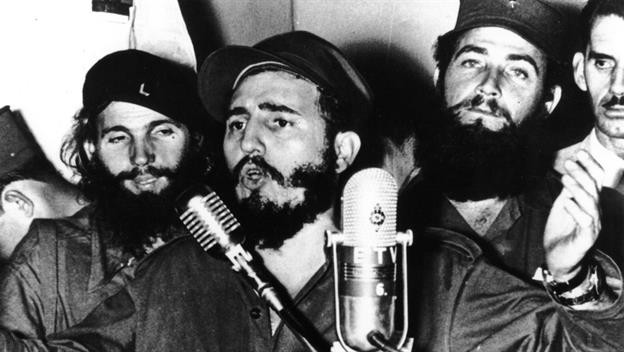
1959: Batista forced out by revolution

History.com has this for 1 January:


On this day in 1959, facing a popular revolution spearheaded by Fidel Castro’s 26th of July Movement, dictator Fulgencio Batista fled the island nation. Amid celebration and chaos in the capitol of Havana, the US debated how best to deal with the radical Castro and the ominous rumblings of anti-Americanism in Cuba.
The American government had supported Batista, a former soldier and Cuban dictator from 1933 to 1944, who seized power for a second time in a 1952 coup. After Castro and a group of followers, including the South American revolutionary Che Guevara (1928-1967), landed in Cuba to unseat the dictator in December of 1956, the US continued to back Batista. Suspicious of what they believed to be Castro’s leftist ideology and worried that his ultimate goals might include attacks on the US’s significant investments and property in Cuba, American officials were nearly unanimous in opposing his revolutionary movement.
Cuban support for Castro’s revolution, however, grew in the late 1950s, partially due to his charisma and nationalistic rhetoric, but also because of increasingly rampant corruption, greed, brutality and inefficiency within the Batista government. This reality forced the US to slowly withdraw its support from Batista and begin a search in Cuba for an alternative to both the dictator and Castro; these efforts failed.
On 1 January 1959, Batista and a number of his supporters fled Cuba for the Dominican Republic. Tens of thousands of Cubans (and thousands of Cuban-Americans in the US) celebrated the end of the dictator’s regime. Castro’s supporters moved quickly to establish their power. Judge Manuel Urrutia was named as provisional president. Castro and his band of guerrilla fighters triumphantly entered Havana on 7 January 1959.
The US attitude toward the new revolutionary government soon changed from cautiously suspicious to downright hostile. After Castro nationalized American-owned property, allied himself with the Communist Party, and grew friendlier with the then-Soviet Union, America’s Cold War enemy, the U seveSred diplomatic and economic ties with Cuba and enacted a trade and travel embargo that remained in effect untl recently. In April of 1961, the US launched the Bay of Pigs invasion, an unsuccessful attempt to remove Castro from power. Subsequent covert operations to overthrow Castro, born on 13 August 1926, failed and he went on to become one of the world’s longest-ruling heads of state. Fulgencio Batista died in Spain at the age of 72 on 6 August 1973. In late July of 2006, an unwell Fidel Castro temporarily ceded power to his younger brother Raul. Fidel Castro officially stepped down in February 2008.
Rico says he's still hoping to get there...

China's second carrier


Time has a BBC article about China's new warship:
China is expanding its navy with addition of a second aircraft carrier, the country’s Defense Ministry has announced. Unlike its first aircraft carrier, a refurbished, secondhand Russian ship built more than 25 years ago, the new vessel will be domestically constructed, but non-nuclear, the BBC reported.
The announcement comes at a time of high tension in the South China Sea, where Beijing is pressing extensive territorial claims and is embroiled in disputes with several countries over the sovereignty of the area’s numerous reefs and islets. The South China Sea is thought to have extensive oil and gas deposits.
The BBC quoted Defense Ministry spokesman Yang Yujun as saying that the new carrier would have “many areas of improvements and enhancements” compared with the first.
Rico says it feels more and more like 1939 all the time...
 

Casino Deposit Bonus