05 April 2013

Nuke strike?

Military.com has an article by Yong-Ho Kim and Jean H. Lee about the North Koreans:
North Korea warned that its military has been cleared to attack the United States using "smaller, lighter and diversified nuclear" weapons, while the US said it was strengthening protection in the region and seeking to defuse the situation.
Despite the intense rhetoric, analysts do not expect a nuclear attack by North Korea, which knows the move could trigger a destructive, suicidal war that no one in the region wants. It's not believed to have the ability to launch nuclear-tipped missiles, but its other nuclear capabilities aren't fully known.
Defense Secretary Chuck Hagel said Washington was doing all it can to defuse the situation. The Pentagon also will deploy a missile defense system to the Pacific territory of Guam to strengthen regional protection against a possible attack.
The strident warning from Pyongyang is the latest escalating threats from North Korea, which has railed against joint US and South Korean military exercises taking place in South Korea, and has expressed anger over tightened sanctions for its February nuclear test.
Acting on one of its threats, North Korean border authorities have refused to allow entry to South Koreans who manage jointly-run factories in the North Korean city of Kaesong. Trucks carrying cargo and South Korean workers were turned back twice this week.
This spring's annual US-South Korea drills have incorporated fighter jets and nuclear-capable stealth bombers, though the allies insist they are routine exercises. Pyongyang calls them rehearsals for a northward invasion.
The foes fought on opposite sides of the three-year Korean War, which ended in a truce in 1953. The divided Korean Peninsula remains in a technical state of war six decades later, and Washington keeps 28,500 troops in South Korea to protect its ally.
Hagel said Washington was doing all it can to defuse the situation, echoing comments a day earlier by Secretary of State John Kerry. "Some of the actions they've taken over the last few weeks present a real and clear danger and threat to the interests of our allies, starting with South Korea and Japan, and also the threats that the North Koreans have leveled directly at the United States regarding our base in Guam, threatened Hawai'i, threatened the West Coast of the United States," Hagel said recently.
In Pyongyang, the military statement said North Korean troops had been authorized to counter US "aggression" with "powerful practical military counteractions," including nuclear weapons. "We formally inform the White House and Pentagon that the ever-escalating US hostile policy toward the DPRK and its reckless nuclear threat will be smashed by the strong will of all the united service personnel and people and cutting-edge smaller, lighter, and diversified nuclear strike means," an unnamed spokesman from the General Bureau of the Korean People's Army said in a statement carried by state media, referring to North Korea by its formal name, the Democratic People's Republic of Korea. "The US had better ponder over the prevailing grave situation."
However, North Korea's nuclear strike capabilities remain unclear. Pyongyang is believed to be working toward building an atomic bomb small enough to mount on a long-range missile. Long-range rocket launches designed to send satellites into space in 2009 and 2012 were widely considered covert tests of missile technology, and North Korea has conducted three underground nuclear tests, most recently in February.
"I don't believe North Korea has to capacity to attack the United States with nuclear weapons mounted on missiles, and won't for many years. Its ability to target and strike South Korea is also very limited," nuclear scientist Siegfried Hecker, a senior fellow at the Center for International Security and Cooperation at Stanford University, said this week.
"Even if Pyongyang had the technical means, why would the regime want to launch a nuclear attack, when it knows that any use of nuclear weapons would result in a devastating military response and would spell the end of the regime? " he said in answers posted to CISAC's website.
In Seoul, a senior government official said that it wasn't clear how advanced North Korea's nuclear weapons capabilities are. But he also noted fallout from any nuclear strike on Seoul or beyond would threaten Pyongyang as well, making a strike unlikely. He spoke on condition of anonymity because he wasn't authorized to speak publicly to the media.
North Korea maintains that it needs to build nuclear weapons to defend itself against the United States. North Korean leader Kim Jong Un recently led a high-level meeting of party officials who declared building the economy and "nuclear armed forces" as the nation's two top priorities.
Rico says that Kim is just crazy enough to do this...


History for the day

Rico says he wonders if he remembers too much history, or if others remember too little, but how is it that a German company picked that for a product name?

Wrestling a firehose

Rico says his friend Dave sends this:
Capturing the unruly, ever-changing Internet is like trying to pin down a raging river.
But the British Library is going to try.
For centuries the Library has kept a copy of every book, pamphlet, magazine, and newspaper published in Britain. Starting on Saturday, it will also be bound to record every British website, e-book, online newsletter and blog in a bid to preserve the nation’s “digital memory”.
As if that’s not a big enough task, the library also has to make this digital archive available to future researchers– come time, tide, or technological change.
The Library says the work is urgent. Ever since people began switching from paper and ink to computers and mobile phones, material that would fascinate future historians has been disappearing into a digital black hole. The Library says firsthand accounts of everything from the 2005 London transit bombings to Britain’s 2010 election campaign have already vanished. “Stuff on the Web is ephemeral,” said Lucie Burgess, the Library's head of content strategy. “The average life of a web page is only 75 days, because websites change, the contents get taken down. If we don’t capture this material, a critical piece of the jigsaw puzzle of our understanding of the twenty-first century will be lost.”
The Library is publicizing its new project by showcasing just a sliver of its content: a hundred websites, selected to give a snapshot of British online life in 2013, and help people grasp the scope of what the new digital archive will hold.
They range from parenting resource Mumsnet to online bazaar Amazon Marketplace to a blog kept by a nine-year-old girl about her school lunches.
Like reference collections around the world, the British Library has been attempting to archive the Web for years in a piecemeal way and has collected about ten thousand sites. Until now, though, it has had to get permission from website owners before taking a snapshot of their pages. That began to change with a law passed in 2003, but it has taken a decade of legislative and technological preparation for the library to be ready to begin a vast trawl of all sites ending with the suffix .uk.
An automated web harvester will scan and record 4.8 million sites, a total of a billion web pages. Most will be captured once a year, but hundreds of thousands of fast-changing sites such as those of newspapers and magazines will be archived as often as once a day.
The Library plans to make the content publicly available by the end of this year. “We’ll be collecting in a single year what it took three hundred years for us to collect in our newspaper archive,” which holds 750 million pages of newsprint, Burgess said.
And it is just the start. Librarians hope to expand the collection to include sites published in other countries with significant British content, as well as Twitter streams and other social media feeds from prominent Britons.
The archive will be preserved at the London institution and at five other British and Irish “legal deposit libraries”: the national libraries of Wales and Scotland, as well as university libraries at Oxford, Cambridge, and Trinity College in Dublin.
This is not the biggest attempt to archive the digital universe. The nonprofit, San Francisco-based Internet Archive– which developed the Web-crawling technology the Library is using– has collected 240 billion pages since 1996 on its Wayback Machine at archive.org.
The Library of Congress in Washington, D.C., preserves American digital content, such as e-books and e-journals, but does not routinely save all websites. “The Library of Congress is committed to saving e-books, but it is not committed to saving what everybody is saying about e-books on the Web,” said technology historian Edward Tenner.
Britain is one of the first countries to commit in law to capturing its entire digital domain.
The challenge is not just saving the material, but preserving it. The British Library, which has a collection of 150 million items as much as three thousand years old, says it wants researchers in future centuries to have access to the content. But anticipating changing technology can be tricky; some years ago it was suggested the library’s vast collection should be saved to CD-ROM. To ensure the collection doesn’t decay, there will be multiple self-replicating copies on servers around the country, and staff will transfer files into updated formats as technology evolves.
Tenner says keeping up with technology is only one challenge the project faces. Another is the inherently unstable nature of the Web. Information constantly mutates, and search engines’ algorithms can change results and prices in an instant, as anyone who has booked airline tickets online knows. “It is trying to capture an unstable, dynamic process in a fixed way, which is all a librarian can hope to do, but it is missing one of the most positive and negative aspects of the web,” Tenner said. “Librarians want things as fixed as possible, so people know where something is, people know the content of something. The problem is, the goals of the library profession and the structure of information have been diverging.”
British Library spokesman Sanderson acknowledged that this is new territory for an institution more used to documents written on parchment, paper and the fine calfskin known as vellum. “Vellum; you don’t need an operating system to read that,” he said.
Rico says this is massive, literally...

Driving

Rico says his friend Dave sends a non-perv video, though of a guy with serious testosterone issues:

More gubs for the day

Allison Steele and Amy Worden have an article in The Philadelphia Inquirer about gubs:
On a day when Connecticut and Maryland legislators ushered in historic new gun laws, a bipartisan lineup of Pennsylvania legislators and law enforcement officials put forth a bill that would slap an added mandatory two-year prison term on anyone caught with an illegal firearm, but only in Philadelphia.
"This is not about gun control," Philadelphia District Attorney Seth Williams said, flanked by politicians and officials from the City and suburbs. "People who carry guns illegally are the people who are shooting people, murdering people, pistol-whipping people, threatening witnesses... We need a game-changer here in Philadelphia."
Democratic State Senator Larry Farnese, who cosponsored the bill with Republican Representative John Taylor, said the city that both men represent is in the throes of "an epidemic of gun violence" and that law enforcement agencies have long requested stricter gun laws. "No more bullshit," Farnese said. "No more screwing around. This has to happen."
Taylor described the bill as "a crime-fighting tool", and said he and Farnese would work to get it to Governor Corbett's desk as soon as possible.
Two suburban Republican district attorneys, Montgomery County's Risa Vetri Ferman and Delaware County's John Whelan, both supported the bill, saying that criminals arrested in their counties often committed earlier gun crimes in Philadelphia. "I have no doubt that a safer Philadelphia is a safer Delaware County," Whelan said.
State Senator Stewart Greenleaf, the Republican chairman of the judiciary committee, said that he supports the idea of increasing the grading of the crime from a misdemeanor to a third-degree felony, but has concerns about the application of mandatory minimums.
"We need to do something about the issue of violent crime in Philadelphia," said Greenleaf, whose committee will review the bill. "But, generally, I don't support mandatory minimum sentences, because they are difficult to apply. You can have an egregious straw purchaser with twenty guns sales on the one hand, or someone whose license to carry has expired and is otherwise an upstanding citizen getting the mandatory minimum."
Williams said that the bill targets only those who buy or possess guns illegally.
The backdrop for the announcement was the headquarters of the Philadelphia Police Department, which last year arrested about a thousand people for illegal gun possession. Eighty-five percent of Philadelphia's 331 homicides last year were committed with guns, Williams said, and not one of those firearms was obtained legally. In light of those facts, the Democratic district attorney said, the bill should not be considered controversial.
Indeed; the proposal outlined is markedly less far-reaching than the gun law that Connecticut Governor Dannel P. Malloy signed, which tightens restrictions on assault weapons and requires universal background checks for every gun purchase. The bill was that state's response to the December elementary-school shooting in Newtown, a massacre that prompted a national discussion about gun laws.
Legislators in Maryland, meanwhile, passed a bill that would ban the sale of assault-type weapons, set a limit on ammunition magazines, and require fingerprints and a license to buy a handgun.
And in Colorado, the site of two of the worst mass shootings in the nation's history, lawmakers recently passed a bill requiring background checks for all purchases, as well as one that limits the size of magazines. This week President Obama visited the state to highlight its laws, describing Colorado's efforts as proof that "there doesn't have to be a conflict between protecting our citizens and protecting our Second Amendment rights."
Pennsylvania, with its thousands of licensed hunters, has long been one of the most pro-gun states in the east, with strong National Rifle Association membership and GOP majorities in both chambers of the legislature that take seriously their NRA ratings. In the vast western territory outside the urban and suburban parts of the state, politicians in both parties have historically opposed gun control.
But in the post-Newtown world, there have been signs of a gradual shift, including a recent Franklin and Marshall College poll that found 43 percent of registered Pennsylvania voters favor enacting more laws to regulate gun ownership.
Shira Goodman, executive director of CeaseFirePA, which lobbies for tougher gun limits, said she was optimistic about the chances that the Philadelphia bill will be passed.
"It would be hard for people to be against this," she said.
Even so, state House Majority leader Mike Turzai (a Republican from Allegheny) said through a spokesman that he feels Pennsylvania's existing gun laws are working. "Looking at statistics from Pennsylvania State Police data, while there has been a steady increase in gun ownership, there has been a steady decrease in violent crime," said his spokesman, Steve Miskin.
The NRA's Pennsylvania lobbyist, John Hohenwarter, said he has not yet reviewed the bill, but said he thought gun laws should be consistent throughout the state. He also voiced concerns about innocent gun owners being targeted. "The NRA has consistently supported measures that target criminals," he said. "However, we don't want to unintentionally throw the same net over law-abiding citizens."
Goodman said she hopes the proposed Philadelphia bill will open the door for similar laws to be sought in other cities, as well as for broader changes in state law. "Harrisburg has to take some action on behalf of the communities they represent," she said, "and we can use this as a starting point. It cannot remain okay to do nothing."
Rico says he's not sure you can differentially control gubs based on your location, but the courts will have to figure it out...

New stupidity

Sean Collins Walsh has an article in the Philadelphia Daily News about a new tax:

Need a reason to drink? How about improving the futures of Philadelphia's schoolkids?
Mayor Nutter and the City Council are rarely on the same page these days, but the possibility of increasing the "liquor-by-the-drink" tax to help pay for the School Reform Commission's request for $60 million seems to be gaining traction on both sides.
City Council President Darrell Clarke has pledged support for increasing the tax, which now adds ten percent to your bar tab (on top of the sales tax) and sends it to the schools. Nutter said that increasing the tax by half (to fifteen percent per drink) is an option his administration is considering. In 1994, then-Councilman Nutter voted in favor of creating the tax, which now brings in more than $45 million per year. "President Clarke and I have talked about that, and I am certainly interested in that kind of proposal, but my track record on that one is pretty clear," Nutter said. The 1994 bill "was a tough vote for a lot of folks but I thought it was the right thing to do then and it's certainly something that we should explore now."
Clarke spokeswoman Jane Roh wrote in an email that the Council president "supports increasing this tax to bolster an annualized revenue stream for the schools".
Pat Conway, president of the Pennsylvania Restaurant and Lodging Association, said that while businesses don't like the tax, it's the customers who usually absorb its cost. "It would be a tough pill to swallow for restaurants and taverns and for the entire hospitality industry, but it's actually more of a consumer issue," Conway said.
Increasing the tax is no silver-bullet cocktail shaker for fully funding the schools' request, so the Council and the Mayor would have to find money in other places to reach the sixty million dolalrs the schools say they need to plug their enormous budget gap.
Nutter supports funding the request, but has been elusive as to how he wants to get that done. He recently addressed criticism that his administration hasn't yet presented a plan, saying he wants to first develop one with the Council. "We don't have a plan today, and we certainly don't have all the answers today, and we don't have to have a plan and all the answers today. Our budget process, at least under the charter, is completed by the end of May," he said.
Some on the Council, including Clarke, have not committed to providing the full sixty million, arguing that after two years of city property-tax hikes for the schools, it's Harrisburg's turn.
Nutter, however, said that he thinks Philly needs to show its commitment first to get more money out of the state. "It would put us at that much worse of a situation from a discussion or negotiation standpoint to somehow seek additional funding from the Commonwealth of Pennsylvania, while some might suggest that the City would not be putting dollars on the table," he said. "I have to reject that kind of strategy."

Rico says that if there's one way to guarantee more business in bars and liquor stores outside the city...

Gubs for the day

Rico says this doggerel is from his childhood friend Robert:
>
> The following is dedicated to you upon obtaining your sixty-second year. The friendship of a decent man is a gift and a treasure beyond all price.
>
> HOW TO SHOOT A GUN, pt. 1
> (Or: Point it in the Right Direction)
>
> Now shootin' guns, don't ya know,
> Ain't as simple as ya might suppose-
> There's the weapon itself, and what goes in,
> And where ya got such pieces 'o tin
> Followed by where either were made-
> Why all too soon , it's a great parade!
> And to feed them all, that's quite a trick
> And heal them all, both the injuried and sick?
> And the farmers, and makers of diverse things,
> The lists grow endless, with too many strings:
> For it's taken the whole of history to grow
> Those things called guns, as we've come to know.
> No, don't think of shooting as simple at all
> But, rather as power devolved to the small!
> Use the power well. Know which targets ya shoot
> And what's behind that, should it go through-and-through.
> Make sure before committing some deeds,
> That only a shooting can fulfill your needs.
> For they are only tools, both ammo and guns
> And tools left alone can't get a job done
> They've no motivation, can't act on thier own.
> This you must supply, so practice at home
> But these most of all, say the great and the full
> Know why you're shooting, before triggers get pulled
> Don't jerk it now, not even to sneeze...
> Exhale half a breath, then squeeze.

04 April 2013

Not really Mars, yet


Members of the Crew 125 EuroMoonMars B mission return after collecting geologic samples for study at the Mars Desert Research Station (MDRS) in the Utah desert on 2 March 2013.

Mount Sharp (which isn't) in a panoramic image made from a mosaic of images taken by the Mast Camera on NASA's Mars rover Curiosity.

That whistling sound...

...is the shithammer coming down if the Iranians get the bomb:

Not nice


Katerina Nikolas has an article at Digital Journal about the under-reporting of rape in Europe:

High profile-gang rapes in India have been in the headlines since December. The phenomenon is growing across Europe, too, but tends to be under-reported, due to the high incidence of Muslim perpetrators, which makes it politically incorrect to mention.
In December of 2011 a Swedish mother-of-two was subjected to a brutal gang-rape by twelve Afghan immigrants in a refugee camp in Mariannelund. Reports stated that "the rape was oral, anal, and vaginal, sometimes with three rapists inside her at the same time, while everybody was cheering and clapping. The gruesome rape marathon lasted for seven hours. Eleven suspects may have been involved, taking turns while drinking and getting high on drugs. The asylum seekers were cheering and clapping their hands during the rape marathon while calling the victim "whore" and "slut".
According to Vimmerby Tidning: "The woman went into shock while the rapes were still underway, and has since been in a heavily traumatised state. She is now subject to nightmares and panic attacks, and lives in a psychiatric clinic. She is bound to a wheelchair due to damages to her abdomen, and suffers from faecal incontinence."
The main perpetrator, Rafi Bahaduri, 25, had already committed four other rapes in Sweden. The case is not unique; there is a growing trend of gang-rapes perpetrated against white women by Muslim rapists.
In the UK, there has been a steady stream of cases where primarily under-privileged young English girls have been targeted, groomed, and raped by gangs of what the British press euphemistically refers to as Asian men. However, the published names of the perpetrators are primarily of Pakistan and Afghanistan origin when the gang rapists appear in court. The Asian gangs do not contain rapists from China, Japan, or the Philippines.
Cases have been reported in Rochdale, Rotherham, Derby, Bradford, Blackpool; the list goes on. An article regarding the phenomenon in Standpoint notes: "According to some of the mothers, a fear of being branded racist makes many of the police and social services reluctant to investigate the crimes as organised and connected. One mother from Rotherham, whose fourteen-year-old daughter was groomed into prostitution and multiply raped during a twelve-month period, told me that almost every man convicted of these crimes in the north of England is from Pakistan, but that the authorities insist that it is not relevant."
More and more cases are reported across Europe. The following is just a very small sample (some figures indicate five thousand gang-rapes occur in France alone each year):
• In October of 2011, a British woman was brutally gang-raped by five Afghan refugees in Banja Koviljaca, Serbia. According to the Austrian Times, the men were living in a local refugee centre housing 2,500 illegal immigrants.
• In June of 2011, a fourteen-year-old Norwegan girl, Eva Helgetun, committed suicide after being gang-raped by three teenage migrants.
• In January of 2013, the Local reported a 22-year-old woman was gang-raped by five men in Stockholm, the first of three reported gang-rapes in the city this year. Eight Muslim male teenagers have been arrested on suspicion of aggravated rape in connection with the three incidents.
• In March of 2013, a British tourist was gang-raped by three Arab men in a Spanish resort.
The Archbishop of Cranmer's blog details a high-profile disturbing case in France where two teenage girls were the prolonged victims of constant gang-rapes by dozens of Muslim teenagers. Cranmer states that all the men involved that were eventually convicted were Muslims, which leads him to question: "Why is the issue of gang-rape committed by young men identified as belonging to a particular minority background consistently suppressed? Are there reporting restrictions? Infringement of their human rights? A conspiracy of silence?"
The silence across the mainstream media in Europe regarding the growing number of gang-rapes against white women by Muslim men and grooming gangs is indeed deafening.

Rico says that, he, of course, has no issue with calling a bunch of wog rapists dead men walking...

Those nice Islamists

Rico says they're real, and they really do hate us:

A good idea, maybe

Tyler Falk has a SmartPlanet.com article about a new farm in town (literally):
Whole Foods is using the rooftop of its new Brooklyn, New York store to make the dreams of locavores everywhere come true. It’s building a massive, twenty-thousand-square-foot greenhouse on top of the new store to provide incredibly fresh produce grown, pesticide-free, with an innovative hydroponic system.
The upscale grocery chain is partnering with Gotham Greens, an urban farm company based in Brooklyn, on the project, the first commercial-scale greenhouse farm integrated with retail in the United States. Imagine, tomatoes, grown in the middle of a New York City winter, picked from the vine and on the shelves in twenty minutes.
Talk about your closed-loop food chain. “This project takes the discussion from food miles to food footsteps,” said Viraj Puri, Gotham Greens co-founder, in a statement. “Our greenhouse will provide Whole Foods Market  shoppers with access to the freshest, most delicious leafy greens, herbs, and tomatoes, that will be grown year-round right above the store’s produce department.”
Not only is this a smart move by Whole Foods because it provides customers with ultra-fresh produce (and boosts its sustainability cred), but it makes sense economically, Ariel Schwartz reports at Fast Company:
Gotham Greens is paying to build the greenhouse, and the grocery chain will simply buy the pesticide-free produce as they would from any other farm. If Whole Foods decides that it can’t handle all the vegetables emerging from the greenhouse, Gotham Greens can sell the excess produce to other clients.
And if all goes well with this experiment, it’s a model that could be used in future stores.
Rico says the local Whole Foods is building a new facility up the street; we'll see if they do a rooftop farm...

What will Apple deliver?

Slate has an video about the new iPhone:
Rico says he can hardly wait...

And that's why

David Weigel has another Slate article about gubs:
Aaron Blake makes a great catch from the national Quinnipiac poll:
More than nine in ten Americans (ninety-one percent) support the idea of universal background checks for purchasing firearms, according to a new Quinnipiac University poll. But nearly half of those polled also said they thought the establishment of such checks would result in the government confiscating guns that had been purchased through legal channels.
Just 38 percent of those polled said background checks wouldn’t lead to such confiscations, compared to 48 percent who said they would. So, a national gun registry is illegal. It has been ever since the 1986 passage of the Firearm Owners Protection Act. Look over there:
No such rule or regulation prescribed after the date of the enactment of the Firearms Owners’ Protection Act may require that records required to be maintained under this chapter or any portion of the contents of such records, be recorded at or transferred to a facility owned, managed, or controlled by the United States or any State or any political subdivision thereof, nor that any system of registration of firearms, firearms owners, or firearms transactions, or dispositions be established. Nothing in this section expands or restricts the Secretary’s authority to inquire into the disposition of any firearm in the course of a criminal investigation.
This law regularly kills law enforcement attempts to build a registry of firearms. You could pass a law that changed this, and legalized gun registration, but that's not part of the bill. There's just an inchoate fear that background checks will get us there, and while Democrats think they've banished the ghost, they haven't.

Rico says they're gonna have to work harder to put this one to rest...

Upstart gun lobby

Josh Voorhees has a Slate article about gubs:
In the wake of Newtown, and during the debate over gun control and safety that has since ensued, most of the pro-gun attention has been on the National Rifle Association, the largest, best-known and best-funded gun lobby in the country. But The New York Times introduces a second pro-gun player this morning, one that is doing its fair share of behind-the-scenes work to derail any and all efforts to strengthen existing gun laws: Gun Owners of America.
According to an an endorsement attributed to Ron Paul that's splashed across the top of the group's website, it's the "only no-compromise gun lobby in Washington". Given the NRA's answers to Newtown, that's quite a bold claim; from the way The Times tells it, it just may be true:
Many lawmakers and gun safety advocates believe Gun Owners of America’s rising profile and heavy membership drive has led the NRA to take a more aggressive stance against measures it once supported, like an expansion of background checks to include private gun sales. (In 1999, Wayne LaPierre, the chief executive of the NRA said there should be “no loopholes anywhere, for anyone” on gun sale background checks.) Part of the group’s mission, executive director Larry Pratt said, is to stay on top of the NRA "when we don’t think they’ve gone far enough." ...
Gun Owners of America’s central mission now is to prevent the passage of several bills about to hit the Senate floor. It is also lobbying for a House bill that would eliminate gun-free school zones. The group’s positions tend to veer farther right than those of the NRA.  Instead of expanding background checks, Pratt would like to unravel the existing ones on gun purchases, fearing they will lead to a national gun registry. “We have opposed them from the beginning,” he said, “because there will be mission creep.”
Given the NRA's size, it's not a total surprise that a smaller interest group would able to stake out territory to its right. But it's noteworthy for the impact that's having. When Senator Tom Coburn, an Oklahoma Republican, backed away from bipartisan talks to expand background checks earlier this year, he did so after Gun Owners of America and its members flooded the senator's office with emails and phone calls to make it, in the words of the paper, "exceedingly clear to the Senator that an enhanced background check law would not be tolerated",
Democratic staffers likewise tell the paper that other Republicans they've approached to co-sponsor a background check bill were quick to point to the GOA as the most obvious reason not to. While the group's bank account is relatively paltry when compared to the NRA's (nearly two million dollars in total revenue in 2011,compared to over two hundred million for the NRA, its members often get Tea-Party-loud, inundating lawmakers' offices with calls and backing only the most conservative of candidates in GOP primaries back home. While the GOA obviously doesn't have the power of the deep-pocketed NRA, it clearly has power.
When it comes to the voting records of lawmakers, the GOA is also a tougher grader than the NRA. While the better-known organization awards A-ratings to Democratic senators like Max Baucus of Montana and Mark Warner of Virginia (A+ in Baucus' case), the upstart group factors in non-gun legislation (like Obamacare) to hand those senators a D- and F, respectively. On the other end of the spectrum, the GOA gives top marks (an A+) to only five lawmakers, half as many as the NRA does. According to the Center of Responsive Politics, which tracks political contributions, the GOA hasn't donated a penny directly to a Democratic lawmaker since 2000. In contrast, the NRA wrote checks to 26 Democrats in the House and one in the SenateJoe Manchin— in the last election cycle alone.
Obviously it's difficult to quantify exactly how much influence each group wields in Washington but, if nothing else, the NYT story is a reminder that, as much as the NRA is often portrayed as the exclusive mouthpiece of the pro-gun crowd (a group that includes both gun owners and gun makers, among others), it's not the only one working to defeat any substantive gun control legislation.

Rico says gotta have everybody working on this one...

Mother of all jihadist jokes

Rico says his friend Dave sends a 'merely' racist joke:
Two Middle Eastern mothers are sitting in a cafe chatting over a plate of beans and a pint of goat's milk. The older of the two pulls a small folder out of her handbag and, flipping through photos, they start reminiscing. ''This is my oldest son, Mujibar. He would have been 24 years old now."
"Yes, I remember him as a baby," says the other mother cheerfully.
"He's a martyr now, though." the mother confides.
"Oh, so sad, dear..." says the other.
"And this is my second son, Khalid. He would have been 21."
"Oh, I remember him," says the other happily, "he had such curly hair when he was born."
"He's a martyr, too..." says the mother quietly.
"Oh, gracious me..."says the other.
"And this is my third son. My baby. My beautiful Ahmed. He would have been 18," she whispers.
"Yes," says the friend enthusiastically, "I remember when he first started school..."
"He's a martyr, also," says the mother, with tears in her eyes.
After a pause and a deep sigh, the second Muslim mother looks wistfully at the photographs and, searching for the right words, says: "They blow up so fast, don't they?"

History for the day, again

Shannon Smith has an article at SmartPlanet.com about the Berlin Wall, still making news:
“The city says I have to.” That’s what luxury housing investor Maik Uwe Henkel of Living Bauhus told the Berliner Zeitung newspaper about his controversial plan to remove a section of the East Side Gallery, the longest remaining section of the Berlin Wall and the world’s longest open-air art gallery. Indeed, removing the wall section was initially the city’s legal obligation— for a previously-planned public bridge project— until Henkel inherited it when he bought the adjacent land for luxury apartments. Meanwhile, he would use the opening in the Wall for access to the construction site.
But that story was too complex— and perhaps too inconvenient— for opponents to the Wall opening, some of whom went further than advocating for the preservation of the East Side Gallery: “No luxury housing in the former death strip” became their mantra instead, drawing the likes of David Hasselhoff and thousands of demonstrators to the site earlier this month in protest of the developer’s plans.
After the city failed to produce a compromise, Henkel’s crews moved forward with the removal of the Wall piece in the early morning hours under police protection, provoking widespread public outcry. The conflict has exposed numerous problems with urban development policy in Berlin, creating bitter rifts in a city already under pressure from skyrocketing real estate prices and mounting public debt.
Through its decoration by 188 artists from twenty countries in 1990, the once-untouchable eastern side of the Berlin Wall was transformed into the East Side Gallery. Rather than serve as a reminder of the city’s dark past, the Wall’s longest remaining strip became a local landmark and tourist attraction, a status reiterated by the return of many original artists to restore their artwork in 2009.
“The East Side Gallery is a place where historical myths, symbolic meaning, opaque construction plans, private investments, exclusive living spaces, artistic projects and autonomous ideas all come together,” writes urban ethnologist and Humboldt University professor Dr. Wolfgang Kaschuba in the Die Zeit newspaper. Referring to the celebrated real estate along Berlin’s major river, Kaschuba noted: “The banks of the Spree have become a playground of urban interests— a strategic area spawning all kinds of polarizations: proponents of privatization versus defenders of the public domain, speculators against creatives, the chic at odds with the scenery. This is a place designed for political controversy.”
But the controversy is a relatively new one, considering the city was suffering from a surplus of public and private space only fifteen years ago. Today, the delay of major projects such as Berlin-Brandenburg Airport (BBI)— whose opening, which was originally set for 2010, is now projected for 2015— have damaged public confidence in the competency of city management. And the recurring failures of politicians to develop city spaces with multiple spheres of interest in mind have only reiterated the many barriers to Berlin’s social and economic development— including that of its creative capital.
“We’re not opposed to entrepreneurs earning money from the property,” East Side Gallery founder Kani Alavi said in an interview with Die Zeit. “But you can’t destroy a historical deed in the name of it. Of course we, as artists, react sensitively to that threat and want to make it clear that this particular stretch of Wall has to be preserved for future generations.”
“We’re not interested in stirring up controversy in the city,” housing investor Henkel told the Berliner Zeitung. “We’re ready to talk, but I expect that from the district mayor as well.”
It was the silence of local district mayor Dr. Franz Schulz and other city officials that Henkel says forced him to move forward with the controversial opening of the wall.
“When the district says to stop work on the wall, then we’ll stop, but we also have to be given alternatives to access our construction site,” Henkel had said at the beginning of March.
Kaschuba told SmartPlanet he believes politicians are struggling to govern a re-awakening city like Berlin with outdated rules. Rapid changes to the city’s social and physical landscape are forcing a number of different interests to the discussion table, he says, which calls for a different brand of politics. “Politicians are learning that ever more expertise will have to come from the public sphere and from various scientific fields, that ‘top down’ policies are no longer working, because everyone’s watching,” Kaschuba said, referring to the well-connected, highly-engaged nature of Berlin’s current public and private stakeholders. “This calls for a new kind of politician— namely the kind that is closely connected to social movements— to play a central role in Berlin’s political future.”
Though investor Henkel has said the removed Wall section will be replaced once construction is complete, Gallery supporters gathered in a makeshift vigil last week nonetheless for the missing artwork, Sky Over Berlin (photo, below), by artists Karina Bjerregaard and Lotte Haubart.

Rico says he'd still like to get back to see it, while there's any left...

Going backstage

Photomag has pictures of what happens when they're making pictures:
Movies were first introduced and shared with the masses in the late nineteenth century and, since then, it has captured the attention of millions of audiences. We are accustomed to these films, full of classic hits, drama, action, thrills, and romance. But there is a whole different world behind these scenes.
Scenes of great and successful movies dissolve us within them, and we forget that it is actually a movie and the sights we see might actually be Hollywood sets. This amazing and unbelievable effect is simply achieved by all that goes on behind the camera, between the scenes. Here we showcase some of the most interesting and amazing behind-the-scenes shots taken from popular films.
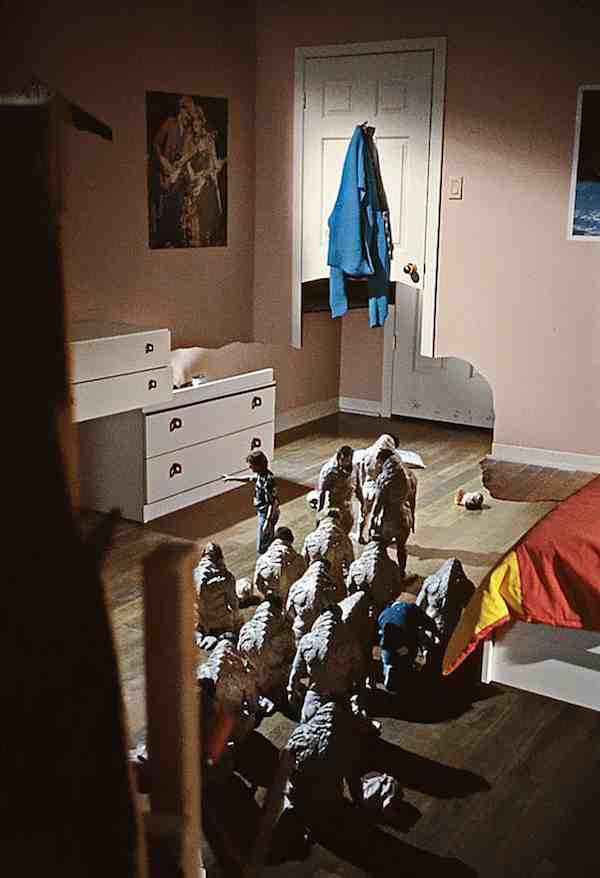
Back to the Future

Django Unchained

E.T.

The credits roll (pre-computer graphics) for The Empire Strikes Back

Ghostbusters

Harry Potter

Inception

Jaws

Planet of the Apes

Stanley Kubrick with his daughter and Jack Nicholson on the set of The Shining

Star Wars

Superman

Terminator

The Dark Knight

The Gate

James Caan in The Godfather

The Hobbit

The Lord of The Rings

The Matrix

The Muppet Movie

Titanic

Putting your money where your mouth is

Josh Lederman has an Associated Press article at Philly.com about the President:

Sharing a bit of budget pain, President Obama will return five percent of his salary to the Treasury in a show of solidarity with Federal workers smarting from government spending cuts. His decision grew out of a desire to share in the sacrifice that government employees are making, a White House official said. Hundreds of thousands of workers could be forced to take unpaid leave if Congress does not reach an agreement soon to undo the cuts.
As the White House warns of dire economic consequences from the $85 billion in cuts that started to hit federal programs last month, the administration has faced repeated questions about how the White House itself would be affected. The cancellation of White House tours in particular has drawn mixed reactions.
A five percent cut from the President's salary of $400,000 per year amounts to $20,000.
The move will be retroactive to 1 March, the day the cuts started to kick in, said the White House official, who was not authorized to discuss the decision publicly and spoke on condition of anonymity.
The notice followed a similar move a day earlier by Defense Secretary Chuck Hagel, who committed to taking a salary cut equal to fourteen days' pay, the same level of cut that other Defense Department civilians are being forced to take. As many as seven hundred thousand civilians will have to take one unpaid day off each week for up to fourteen weeks in the coming months.
Obama's salary is set by law, so he must accept the funds and then write a check to the Treasury for the portion he plans to relinquish. The White House did not say whether Vice President Biden would make a similar gesture.
The five percent that Obama will hand back mirrors the five percent cut that domestic agencies took when the reductions went into effect. The Pentagon's budget took an eight percent hit. Every Federal agency is grappling with spending cuts, which the White House has warned could affect everything from commercial airline flights to classrooms and meat inspections.

Rico says it's a noble gesture (if a bit grandstanding, but, hey, this is politics), but Congress should still be all fired for making it necessary... (And if they fuck up the meat inspections, expect lawsuits.)

Apple for the day, again

We're gonna hear a lot about the Apple television before it actually arrives, and Peter Svensson has an AP article at Philly.com with a reprise of the latest:
It's no secret that Apple wants to get into the living room by making its own television set, and there have been plenty of rumors and reports about how and when it's going to happen. Now an analyst says he's learned that the set will go on sale late this year, for $1,500 to $2,500.
In a research note, Brian White of Topeka Capital Markets says the iTV will be sixty inches on the diagonal, but could also come in fifty- and fifty-five-inch versions. Apple will also release a small iRing that fits on the viewer's finger, allowing the user to control the screen by pointing, White says.
In addition, the set will come with tablet-like mini iTVs with 9.7-inch screens, the same as the full-size iPad, White said. The iTV will be able to send video to the smaller screens wirelessly around the house. The concept is similar to the way in which cable and satellite television companies are starting to let their set-top boxes send video to iPads and other tablets. White says his report is based on gleanings from visits with unnamed Chinese and Taiwanese companies that supply Apple with components.
Apple doesn't comment on future products before its launch events, but then late company co-founder Steve Jobs told biographer Walter Isaacson that he wanted to remake the television and had figured out a way to do it. Last year, there were numerous analyst reports that said Apple would launch a television set in 2012.
Apple does sell an Apple TV, but it's a small box that connects to a television set to display movies and shows from iTunes.
Apple shares rose $2.20 to close at $431.99 on Wednesday, as the tech-dominated Nasdaq index fell 1.1 percent. Apple's stock is still close to the 52-week low of $419, which it hit a month ago.

Rico says how long do you think it'll be before someone renames the iRing as My Precious? Oops, already did... But, when Rico worked for Apple, the stock was trading at $15, so over four hundred ain't bad. (Though, if you were smart and shorted Apple when it hit $700, you made out like a bandit.)

Solutions to the problem

Rico says he agrees with a commenter ("How to stop mass shootings: 1. Shoot asshole killer in the head. 2. Throw the dead body dumpster where it belongs with the rest of the trash."), but the video speaks for itself:

Future history for the day, maybe

Rico says that, if you believe the religious, it's the end of the world... In November, we find out:

History for the day


Rico says that, when he was in Berlin in 1969, there was a sign by the Wall: Lassen wir vergessen (Lest we forget), with a list of the names of the concentration camps. The GOP should have one of their own...

03 April 2013

Yet more Apple for the day

Doug Aamoth has a Time article about the new iPhone:
The Wall Street Journal reports “people familiar with the device’s production” as saying the next iPhone is on its way for “a possible summer launch”.
Apple released the first four generations of iPhones in the June-July timeframe, while the two most recent versions, the 4S and the 5, were released in October and September, respectively.
The Journal reports that the newest version will be “similar in size and shape” to the iPhone 5, but that Apple is also working on a less-expensive model with “a different casing from the higher-end iPhone” and a possible launch “as soon as the second half of this year”.
Rico says that he just got his damned iPhone 5...

More Apple for the day

Peter Svensson has a Time article about Apple:
It’s no secret that Apple wants to get into the living room by making its own television set, and there have been plenty of rumors and reports about how and when it’s going to happen. Now an analyst says he’s learned that the set will go on sale late this year, for $1,500 to $2,500.
In a research note, Brian White of Topeka Capital Markets says the iTV will be 60 inches on the diagonal, but could also come in 50- and 55-inch versions. Apple will also release a small iRing that fits on the viewer’s finger, allowing the user to control the screen by pointing, White says. His report is based on gleanings from visits with Chinese and Taiwanese companies that supply Apple with components.
Rico says he's not sure he needs that big a television (or will be able to afford one), but he can't wait to see it...

Apple for the day

CNET has an article by Daniel Terdiman about the early days of Apple:
In the common retelling of Apple's history, it was Steve Jobs' and Steve Wozniak's (photo, top) second computer, the Apple II, that launched their fledgling company toward stratospheric growth and financial success. The machine's triumph as a single platform for business software, games, and artistic tools set the stage for the later debut of the first Mac, and later OS X and iDevices.
What many forget (or may not even know) is that when the Apple II was introduced at the inaugural West Coast Computer Faire in April of 1977, it suffered from what, in retrospect, was a glaring shortcoming: it had no disk drive.
Thanks to 35-year-old documents that have recently surfaced after three-plus decades in storage, we now know exactly how Apple navigated around that obstacle to create the company's first disk operating system. In more than a literal sense, it is also the untold story of how Apple booted up. From contracts, signed by both Wozniak and Jobs, to design specs to page after page of schematics and code, CNET had a chance to examine this document trove, housed at the DigiBarn computer museum in California's Santa Cruz Mountains, which shed important new light on those formative years at Apple.
What they show is the process, driven by Jobs' urgency and inspired by Wozniak's technical vision, yet emblematic of their reliance on outside help, behind one of the most vital software projects in Apple's history. Without the project, we now know, Apple's ambitions of selling a serious computer for a wide audience might very well have collapsed, just as the company was on the verge of making the big time.
With its professional-looking (for 1977) injection-molded case and a design aesthetic to match Jobs' perfectionism, the Apple II was a breakthrough product for the time. But, though it was years ahead of the kit-like Apple I that it was meant to replace, the Apple II still only offered a cassette drive.
"They were in trouble," recalled Bruce Damer, founder of the DigiBarn. "With a cassette, you had to wait and wait and wait to load anything, and it was unreliable. It was a hit or miss process. Can you imagine trying to build a company on this?"
Wozniak and Jobs weren't blind to the need for a functional, and powerful, disk drive and a disk operating system to run the system. But despite its deep bench of in-house talent— a roster of eventual Silicon Valley legends, including the likes of Woz himself, Jef Raskin (the "father of the Mac"), John "Captain Crunch" Draper, to name a few— building its own DOS was beyond Apple's ability at the time. The company needed to look elsewhere.
Though the Apple I brought Wozniak and Jobs fame in the largely insular world of enthusiasts, the computer had no case, no power supply, and no keyboard, and failed to generate much interest among business buyers. With the Apple II, however, which Wozniak designed in the fall of 1976, Apple set out to attract a wider audience. It was a decision that laid the groundwork for a more expansive sales and marketing strategy. First item on the agenda: get a disk drive into the system to force the market to take Apple seriously.
"The difference between cassette and disk systems was the difference between hobbyist devices and a computer," said Lee Felsenstein, the creator of the Osborne I, the world's first portable computer. "You couldn't have expected, say, VisiCalc, to run on a cassette system." VisiCalc, the first spreadsheet program, was one of, if not the, single-most important pieces of software in PC history. As Paul Laughton, who wrote Apple's DOS, put it, VisiCalc was "the thing that made microcomputers take off."
That's because it gave businesspeople a reason to spend a lot of money on a new microcomputer. "If you knew VisiCalc, and what it did, and you were a skilled salesperson, and the right person came in the door," said Dan Bricklin, the co-creator of VisiCalc (along with Bob Frankston), "you could probably sell them a fully-loaded machine." Bricklin explained that he and his publisher released VisiCalc for the Apple II first, in part because his publisher, Dan Fylstra, was an Apple fan, and in part because they had an assembler for the 6502 chip that the Apple II was based on. But the decision to go first with the Apple, Bricklin said, was partially based on the fact that the Apple II was more likely than its competitors to have a floppy drive.
For a year, VisiCalc was an Apple exclusive, and, during that time, about a thousand copies of the software were sold a month. That number may seem small today, but at the time, it was significant. Plus, Bricklin said: "it corresponded to a lot of Apples being sold: more than a million dollars in Apple computers being sold every month."
Can you draw a line from Apple's DOS to the company's eventual success through VisiCalc? Felsenstein certainly thinks so. VisiCalc, he said, "was the killer app, the one that made everybody pay attention and realize that you could do real stuff with these devices. They were not toys."
Talk to just about anyone intimately familiar with the Apple II, and one thing you'll hear often is that the disk controller Wozniak designed over the 1977 Christmas holidays for the computer was a proverbial game changer. The chief innovation was making the controller compact by using software while competitors relied on hardware. As Bill Fernandez, then an electronic technician at Apple, remembers it: "the key advantage of Wozniak's design was that it used only six chips instead of the usual sixty to seventy; a huge reduction in size and cost."
Bricklin said Woz' controller was "wonderful," while Felsenstein marveled at its "elegance". Damer called it "masterful." And surely Apple's financial people were happy, because the simple design meant profit margins would be much higher than those on competitors' drives. But no matter how great its disk controller was, Apple had no DOS. Or any way to build one of its own. "They looked around Apple," Damer said, "and no one could write a DOS."
Wozniak's options were few. On the one hand, he told CNET, there were no existing disk operating systems for the 6502 chip. And though the Apple II did have a mini-DOS built into its ROM that could redirect input and output streams to any slot by manual or program command, Wozniak wanted more.
One option was CP/M, a popular OS at the time. But it was known to be clunky, and though Wozniak said he talked to CP/M's creator, Gary Kildall, about operating systems: "I was looking for something easier to use."
Although he knew little about operating systems, Wozniak is confident he could have built a good one. But his co-founder couldn't wait. "Steve Jobs, who didn't have patience for a project that took more than a week, found Shepardson Microsystems and they sounded eager and knowledgeable, so we hired them."
As then-Shepardson employee Paul Laughton remembers it, Wozniak came by one day saying Apple had a disk drive, but no DOS, and was wondering what to do. "I said: 'I know about operating systems.' And so he said: 'Cool, let's have you do it.'"
On 10 April 1978, the contract was signed. For $13,000— $5,200 up front, $7,800 on delivery, and no additional royalties— Shepardson Microsystems would build Apple's first DOS, and hand it over just 35 days later. For its money, Apple would get a file manager, an interface for integer BASIC and Applesoft BASIC, and utilities that would allow disk backup, disk recovery, and file copying. "I sat down and started writing," Laughton recalled. "It was written on punch cards. It was put into a minicomputer and assembled, and the output was paper-taped. Then we proceeded to debug it."
In the recently surfaced documents, which Laughton donated to the DigiBarn, is a wealth of information about the Apple DOS project. From contracts signed by both Wozniak and Jobs to design specs to page after page of schematics and code, this is a treasure trove of Silicon Valley and Apple history. Or, as Damer said he thought upon looking through the papers: "Oh my God, these are possibly the most important Apple documents in history."
"The difference between cassette and disk systems was the difference between hobbyist devices and a computer. You couldn't have expected, say, VisiCalc, to run on a cassette system."
One of the fun parts about reading through the documents is seeing pages filled with Wozniak's own writing. The project, after all, was based on specs Apple's legendary co-founder gave Laughton for how to create a boot disk. Among the treats, for those who can appreciate such things, is Wozniak's hand-drawn diagram (photo, bottom) for his highly regarded floppy disk controller. The margins of the source code also have a series of notes explaining what's going on that are like catnip for true Apple geeks. Looking over the documents, and seeing a comment about "Must not cross page boundary," Apple's sixth employee, Randy Wigginton, who worked closely with Shepardson Microsystems on the project, said: "I forgot how crossing a page boundary added an extra cycle on the 6502."
"The 6502 liked everything to be in neat 256-byte 'page boundaries'," Wigginton explained to CNET by email. "When writing code that had to be rigorous about timing, you had to be careful about crossing a page boundary, otherwise an extra cycle was consumed by the processor. That's why Woz has the note 'Must not cross page boundary' on his code."
For Laughton, who turns 69 this month, his essential role in one of Apple's most important projects was a career highlight. Even in 1978, he could tell Apple was a special company, particularly because he recognized the "genius of Wozniak in the design of the Apple II and the design of the disk drive interface card". He's also had plenty of opportunities to revisit his contribution to Apple. "From time to time, it would come up in conversation and someone would say they had an Apple II, and I'd say I wrote the DOS," Laughton said. "They were like, 'Wow, did you make a lot of money," thinking I probably worked for Apple."
In fact, though, Laughton made about $35,000 a year working for Shepardson at the time. He knows how much he could have made on Apple stock if he'd worked directly for Wozniak and Jobs, but, in 1978, Apple was just another startup, and Laughton enjoyed the steady work writing software for Shepardson's many clients. Besides, he recalled: "I remember talking to Wozniak, and his salary was lower than mine."
Rico says one can only call him The Great and Powerful Woz... (But Shepardson should've taken the royalties.)

Congress, the weasels

Rico says his father forwards this:

The Congressional Reform Act of 20131. No tenure, no pension.
A Congressman/woman collects a salary while in office, and receives no pay when they're out of office.
2. Congress (past, present, & future) participates in Social Security.
All funds in the Congressional retirement fund move to the Social Security system immediately. All future funds flow into the Social Security system, and Congress participates with the American people. It may not be used for any other purpose.
3. Congress can purchase their own retirement plan, just as all Americans do.
4. Congress will no longer vote themselves a pay raise. Congressional pay will rise by the lower of the CPI or three percent.
5. Congress loses their current health care system and participates in the same health care system as the American people.
6. Congress must equally abide by all laws they impose on the American people.
7. All contracts with past and present Congressmen/women are void, effective at the end of 2013. The American people did not make this contract with CongressCongress made all these contracts for themselves. Serving in Congress is an honor, not a career. The Founding Fathers envisioned citizen legislators, so ours should serve their term(s), then go home and back to work.
Rico says he'd go even farther: you get one term, then you have to go home and sit one out, then you can run again...

A hero, depending on your point of view

Bethany Braun has an article about a guy who's a hero (to some of us(:
On 7 December 2012, David Barajas took justice into his own hands when he shot the drunk driver who killed his two sons. This story is heartbreaking, controversial, and will leave people on either side of the fence.
Here are the details:
According to ABC News, last December, Barajas and his sons David Jr., twelve, and Caleb, eleven, were pushing their broken truck back to their home. Barajas’ wife and two younger children were inside the truck. The family was hit by Jose Banda, 20, who was driving drunk.
David Jr. died instantly, while Caleb was rushed to the hospital, and died later from his injuries. When the police showed up at the scene of the crime, they determined that Banda had indeed been drunk, but they also noticed a fatal gunshot wound to his head.
After months of investigation, it was determined that Barajas had shot and killed Banda after he crashed his car into his family.
What now:
Barajas was arrested and is being held on $450,000 bail. The Sheriff’s Department said that “investigators are currently awaiting results of gunshot residue tests which were collected at the scene.”
Obviously this case is confusing. Was justice served? Or did Barajas go too far?
It’s a hard one to answer. As parents, it’s incredibly difficult to imagine ourselves in Barajas’ situation. Maybe we would have wanted to the same thing. Chances are, though, most of us would not have taken action.
The anger and immense sadness that Barajas must have felt in that moment makes me empathize with him, yet I do believe he was wrong in his actions. Either way, this story is heartbreaking, and I hope each family takes the proper time to grieve the loss of their loved ones.
Rico says he hopes never to be in this situation, but suspects he'd kill the other driver, too...

Stealth? Who knew?


Mark Thompson has a Time article about a surprising Iranian aircraft:
Does an alleged stealth aircraft see its shadow if it’s introduced to the world for the first time on Groundhog Day?
Iranian Defense Minister Brigadier General Ahmad Vahidi unveiled the Qaher F-313 fighter on 2 February in Tehran. The debut came as Iran marked the 34th anniversary of the 1979 revolution, which replaced the US-backed Shah with an Islamic regime that has held power ever since. “This advanced fighter jet with unique physical characteristics has a very low radar cross section and therefore is capable of operating at low altitudes,” Vahidi said, according to the Mehr news agency. (Very low radar cross-section is how you say stealth in Farsi, and Qaher is Farsi for Conqueror.)
Western experts have quickly begun picking the plane apart, based on the photographs broadcast on Iranian television. It’s too small overall, its cockpit is too cramped, and it lacks an afterburner nozzle. Nonetheless, the Iranians are proud of their homegrown aerial hotrod. “All its parts, from A to Z, have been manufactured domestically,” Hassan Parvaneh, the Qaher project manager, told state television.
Speaking of domestic production: funny how the West so quickly dismisses Iran’s fighter program, but so profoundly fears its nuclear program. Wonder what would happen if Tehran put more of that on state-run television?
Rico says he wonders where they got that technology?
 

Casino Deposit Bonus